Along with Neville Potter, a PhD graduate of SLLL, Russell Smith has been involved in organizing an event for Bloomsday, the annual celebration in honour of James Joyce’s novel Ulysses (1922), set on Thursday 16 June 1904. The event will take place not on Bloomsday itself (purists be warned) but on the night before, which happens to be a Thursday, 15 June 2017, at the Irish Club in Canberra, and will feature readings from the novel, songs and Irish music, and a two-course dinner. Please find the poster here, distribute this widely and make sure to book early!
Monthly Archives: May 2017
Lunchtime seminar: Mabel Cuesta on Lydia Cabrera
Lydia Cabrera: Ethnography and Forbidden Desires
Thursday 1 June, 1pm Milgate Room, AD Hope Bldg, SLLL
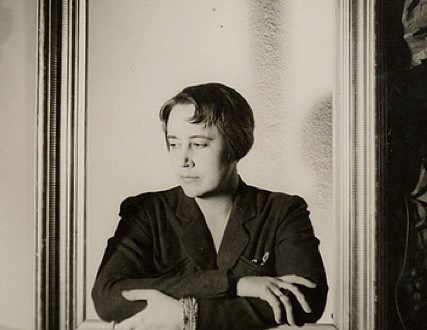
Lydia Cabrera (1899-1991), the most important ethnographer and folk writer in the Cuban archive, was an exile in the United States for the last thirty years of her life –previously she lived in Paris, Madrid, and Havana. In all these cities, she was able to engage well-known female artists and writers who were lesbians as herself and whose financial and emotional support allowed Cabrera to better survive in the homophobic societies she was always living in and struggling against in order to survive as a respected scholar and fiction writer despite her sexual desires. My project will argue that those lesbian and ultimately female alliances are the ones that better served and financially supported Cabrera’s intellectual ambitions.
This presentation is part of a book project that explores the significance of the emergence of these alliances by analysing the traditional mythical connection established between woman and island, as well as the identities produced by female writers who had been historically silenced in Spanish Caribbean fiction, as well as in the anthropological work mostly produced by male scholars. In this regard, I have paid close attention to the treatment of homoerotism, exile, ethnicity, patriotism and the birth of feminism as a tool to confront the male power as well as its alliances with colonial practices.
Dr Mabel Cuesta is Associate Professor of US Latino and Caribbean Literature at the University of Houston.
Invitation: Bloomsday 2017
Along with Neville Potter, a PhD graduate of SLLL, Russell Smith has been involved in organizing an event for Bloomsday, the annual celebration in honour of James Joyce’s novel Ulysses (1922), set on Thursday 16 June 1904. The event will take place not on Bloomsday itself (purists be warned) but on the night before, which happens to be a Thursday, 15 June 2017, at the Irish Club in Canberra, and will feature readings from the novel, songs and Irish music, and a two-course dinner. Please find the poster here, distribute this widely and make sure to book early!
Lunchtime seminar: Monique Rooney on the aesthetics of Rousseau’s amour de soi
Love’s Intermediary: the Aesthetics of Rousseau’s Amour de Soi (Self-Love)
Thursday 25 May, 1pm Milgate Room, AD Hope Bldg, SLLL
‘Love, like perfectibility, is structured like a figure of speech’ writes Paul de Man in a statement that resembles that of a famous psychoanalyst on the unconscious and language. If de Man’s figural ‘Love’ here echoes Lacan’s linguistic unconscious then this mimetic resonance is implied, rather than categorically referenced, in the chapter ‘Self (Pygmalion)’ (Allegories of Reading, 1979) in which de Man engages not with Lacan but with Rousseau’s dramatisation of self-love. For de Man, Rousseau’s Pygmalion (1762) amounts to more than an exploration of vanity. Instead the statue’s metamorphosis—which is structured ‘like a figure of speech’—dramatises the idea that Pygmalion’s artwork is radically other.
The first part of this paper closely engages with the highly rhetorical distinction Rousseau makes between amour propre (love based on vanity, pride or desire for esteem) and amour de soi (self-love) in explicitly philosophical (written) works in which amour de soi is speculatively associated with a pre-linguistic and pre-social moment in time. Turning to de Man’s analysis of Pygmalion, the paper then emphasises the significance of suspension as a figural or dramatic halting of time through which Rousseau’s more elusive version of self-love (amour de soi) is impossibly re-animated and from within the ‘monstrous concatenation’ or ‘mixed genre’ that is Rousseau’s lyric scene (de Man, 1979). How then, the paper asks, might Rousseau’s scene of suspension and reanimation, and its enduring legacy of melodrama, contribute to the transhistorical theorisation of intermediality in the digital age?
Monique Rooney teaches in the English Program, ANU. Her current project further pursues, and applies to an Australian aesthetic context, the ideas about intermediality explored in Living Screens: Melodrama and Plasticity in Contemporary Film and Television (2015).
Lunchtime seminar: Hadley-Williams on 17th c manuscript and its verse
Mixed pleasure: A seventeenth-century manuscript and its verse
The collection and use of vivid contemporary evidence of all kinds, so much a part of the method and works of the reformer, John Knox, were practices continued by later historians of religious history. One such gathering of documents, copied and original, is Robert Wodrow’s of the early eighteenth century, now held by the National Library of Scotland. It includes Wod.Fol.VIII, a version of David Calderwood’s History of the Kirk of Scotland, dated 1636. The manuscript also has its own interest, especially for literary scholars. Fourteen short pieces of verse, in either Latin or Scots, are inserted into the prose text. In several cases the poems are well known from their appearances in John Foxe’s Actes, the histories of Knox and Calderwood, and similar works. In Wod.Fol.VIII, however, these versions of known poems have small or more substantive differences, which help to reveal circulation patterns and the evolution in thinking about the issues they address. A few other poems in Wod.Fol.VIII are not known to occur elsewhere. These are here reported, and briefly studied. The paper will discuss the 1636 manuscript, its copyist, and the verse inclusions.
Janet Hadley Williams is Honorary Lecturer, English and Drama, in SLLL, and President of the Sir David Lyndsay Society. For the Association for Scottish Literary Studies she edited Sir David Lyndsay: Selected Poems (2000). She has edited several essay collections, including (with Priscilla Bawcutt), A Companion to Medieval Scottish Poetry (2006), and (with J. Derrick McClure), Fresche fontanis: Studies in the Culture of Medieval and Early Modern Scotland (2013). Her edition for the Scottish Text Society, ‘Duncane Laideus Testament’ and Other Comic Poems in Older Scots, appeared in 2016.

Lunchtime seminar: Rosanne Kennedy on ‘Shards of Testimony’.
Shards of Testimony: Digital Witnessing to Refugee Lives in Detention
Thursday 11 May, 1pm Milgate Room, AD Hope Bldg, SLLL
This paper explores two contemporary case studies of digital witnessing based on the experiences of refugees and asylum seekers in the Australian offshore border protection regime. First, The Messenger, a podcast from within the detention centre on Manus Island in PNG, broadcasts the voice of Aziz, a young Sudanese refugee who is now in his third year of detention. Aziz and Michael, a journalist in Melbourne, use WhatsApp to communicate. The intimate form of voice recordings enables Aziz not only to report on the daily routines and disruptions that structure life at the camp, but to convey a strong sense of himself and of life in the camp. Second, we consider the Nauru Files, incident reports written by staff at the detention centre on Nauru, leaked to The Guardian and made accessible online in an interactive digital database.
We will map these two cases as a ‘dense digital environment’ generated by an assemblage of technologies that disseminate refugee testimonial now from within a border protection regime that works to render these offshore sites invisible and silent. As Kay Schaffer and Sidonie Smith suggest, digital environments raise provocative questions about how to approach emergent acts and instances of witness. Here we will argue that distinctive assemblages of user, story, interface and device are emerging from these southern spaces, and that, as the streets and squares of Cairo are imprinted in e-witnessing from the Arab Spring, so too the mobilisation of testimony from these camps is a distinctive testimonial culture.
Rosanne Kennedy is Associate Professor of Literature and Gender, Sexuality and Culture at the Australian National University. Gillian Whitlock is Professor of Literature at University of Queensland. They are working on a project on refugee live narrative in a digital era.
Lunchtime seminar: Ash Collins on the forgotten Spinozist
The Forgotten Spinozist: Romain Rolland, Gilles Deleuze, and the Figure of Christ
To this day, the thinking of Spinoza still serves as a powerful tool for those seeking to negotiate the nexus between theological transcendence and the immanence of worldly existence. This paper explores the thought of one of the most important—and yet least remembered—Spinozists within 20th century French intellectual history: the Nobel Prize-winning French novelist, Romain Rolland (1866–1944). Past scholarship has repeatedly identified a divergence between the Catholic orthodoxy against which a youthful Rolland rebelled and the Spinozist non-conformism that shaped his thinking throughout life. By re-reading Rolland’s intellectual engagement with religion through the thinking of Gilles Deleuze, this study counters such critical interpretations and argues that the tension between Catholic orthodoxy and Spinozism cannot purely be seen in terms of a polemical conflict, but rather as the opportunity for a fruitful dialogue that has much to offer our own treatment of the religious question in the 21st century.
Ash Collins is Lecturer in French Studies at the Australian National University. His primary research interests include 20th and 21st century French intellectual history, 20th century French literature, continental philosophy, philosophy of religion, and philosophy of education. He has published his research in journals such as Australian Journal of French Studies, International Journal for Philosophy of Religion, and Educational Philosophy and Theory.