
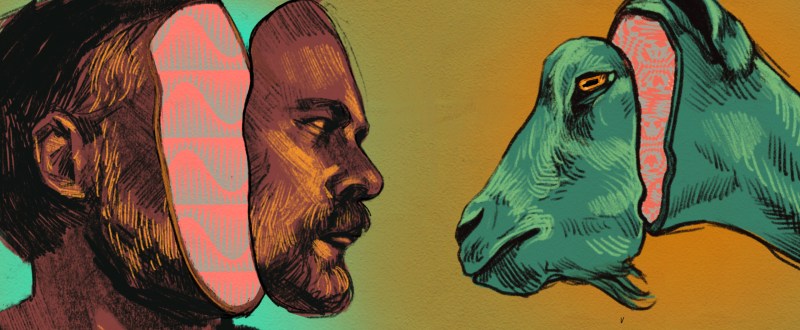
Image Credit: Bronwyn Schuster, Montecristo Magazine.
Please join us for a CuSPP Seminar in person (BPB W3.03) and online on Thursday 25 September from 1-2. Please refer to the CuSPP email or email Thomas.Nulley-Valdes@anu.edu.au for the link.
ABSTRACT: Many writers figure machines in evolutionary terms, as living and evolving organisms. The American science fiction writer Philip K. Dick observed in his 1972 speech “The Android and the Human” that in the last decade “our environment, and I mean our man-made world of machines, artificial constructs, computers, electronic systems, interlinking homeostatic components—all this is in fact beginning more and more to possess . . . animation.” Already in the late nineteenth century, English authors Samuel Butler and George Eliot were thinking of machines as living and evolving organisms. This paper examines how such writers as Dick, Butler, and Eliot rethink what it means to be human by attributing life to their technological environment. It discusses various speculative rhetorical techniques that writers use to look at the human from the perspective not just of another living organism but also of the surroundings of the human themselves. It shows how writers biologize machines by figuring them as cryptic nonhuman organisms that can merge with and act on behalf of their physical environments. It argues that underlying the techno-anthropologies of writers like Dick, Butler, and Eliot is an environmental understanding of life as the dyadic relation between the organism and its surroundings.
SPEAKER BIO: Chris Danta is professor of literature in the School of Cybernetics at the Australian National University and an Australian Research Council Future Fellow (2021–25). His research operates at the intersection of literary theory, philosophy, science, and theology. He is the author of Literature Suspends Death: Sacrifice and Storytelling in Kierkegaard, Kafka, and Blanchot (2011) and Animal Fables After Darwin: Literature, Speciesism, and Metaphor (2018). He is currently working on a book titled Future Fables: Literature, Evolution, and Artificial Intelligence. In 2024, he was elected a Fellow of the Australian Academy of the Humanities.
 cuspp.net