
Please join us for a CuSPP Seminar (Co-hosted with CEMS) in person (ADH Conference Room) and online on Thursday 19 March from 1-2. Please refer to the CuSPP email or email Wesley.Lim@anu.edu.au for the link.
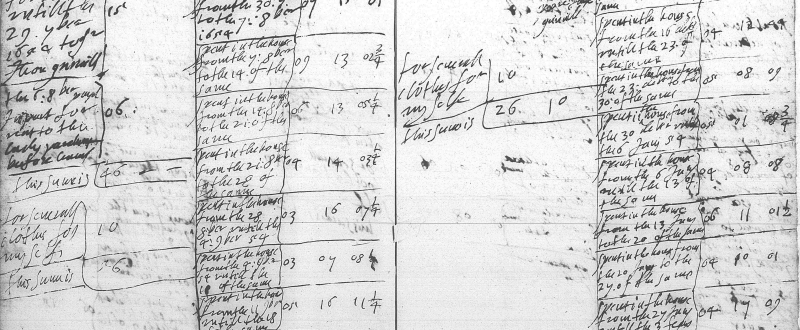
This talk traces the connections between the increasingly prevalent practice of account-keeping and the use of time and numbers in early modern women’s life writings. Using a range of examples from the seventeenth century, I argue that life writings by early modern women represent women’s capacity to manage time, both as a quotidian resource (the profitable use of time) and as a spiritual and long-term resource. This ability depends upon their mastery of a range of literacy skills and practices, but also asserts their centrality to family record keeping, which in turn is crucial to ideas of property, genealogy, and descent. Women’s spiritual diaries and ego-documents operate in the space between past and future that contemporary writers like Henry King and Isaac Ambrose suggested was crucial to preparation for the life to come and tend to narrate the present as always in process. This present continuous is registered at the material level of the texts’ production, which I demonstrate is frequently iterative and recursive as is account-keeping. Additions, rewritings, and returns are expressed materially in many of these manuscripts, as revisions, as pages divided into sections where narratives and text compete with and tumble over each other. Other textual practices, such as note-taking, common-placing and making marginal notations or marks also suggest the non-sequential and non-linear nature of women’s textual engagement. Using the examples of Martha Molesworth and Katherine Austen, I discuss how accounting manifests at a discursive and a material level, and how this is used as a way of managing time.
Danielle Clarke is Professor of Renaissance Language and Literature at University College Dublin. Most of her research and writing has focused on early modern women – looking at their textual output through the widest possible lens, but grounded in close readings of primary texts, poetry in particular. Most recently, she has been working on an edition of the poetry of Lady Anne Southwell (with Vicki Burke and Christina Luckyj). She is in the final stages of writing a monograph called Quotidian Writing and Literary Production:.Forms of Women’s Writing, 1550-1700.
 cuspp.net