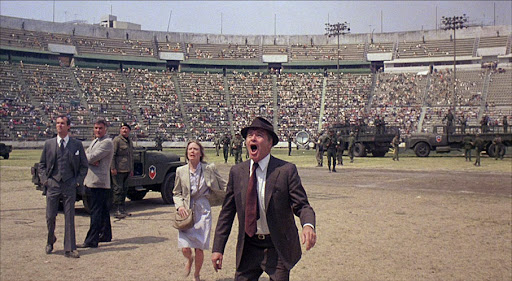
Fabricio Tocco, ‘Thrilling Gringos:  Americans, Europeans and the Secret Liaisons between Latin America and the Thriller’

Image Credit: Costa-Gavras, Missing (1982).

Please join us for a CuSPP Seminar in person (BPB W3.03) and online on Thursday 23 October from 1-2. Please refer to the CuSPP email or email Thomas.Nulley-Valdes@anu.edu.au for the link.

ABSTRACT: The secret liaisons between Latin America and the thriller are older than they seem. Following the southbound journey of gringos—Early Modern Southern European colonisers, nineteenth-century American and British swindlers, Nazi Germany spies, Cold War CIA agents—this presentation traces how the region became inseparable from the genre long before local authors and filmmakers claimed it as their own. The 1906 appearance of the word “thriller” attached to Roy Rockwood’s Jack North’s Treasure Hunt: Daring Adventures in South America, an American adventure novel set in Chile and Peru, is no accident: Latin America’s exotic and dangerous fauna, along with its civil wars and deceptive landscapes, were already paving the way for the genre. An excerpt from the first chapter of my forthcoming book Precarious Secrets: A History of the Latin American Political Thriller (Austin: University of Texas Press, 2025), this presentation examines how Rockwood’s novel and Argentine-English Guillermo Enrique Hudson’s The Purple Land that England Lost (1885) shaped the work of Fritz Lang, Alfred Hitchcock, and Costa-Gavras: the American and European political thriller set in Latin America, an embryonic but key stage in the history of the genre in the region. This presentation argues that what looks like imperialistic appropriation is a secret liaison, where American and European models become difficult to disentangle from Latin America’s later forays into the thriller, and from the fact that genres can always be re-appropriated by those represented within them.

SPEAKER BIO: Dr Fabricio Tocco is a Lecturer in Spanish at SLLL. He is the author of the novel Parece diciembre (2025, Equidistancias) and two books, Latin American Detectives against Power (Lexington, ICFA Book Prize 2022) and Precarious Secrets (2025, University of Texas Press), which inspired the documentary Secretos Precarios (SBS on Demand, 2025).

Elizabeth Keen, “Desperately mortal in the moated grange: a cosmological view of Shakespeare’s Measure for Measure”

Image credit: Image of the world, theatre of the world: Creation, from Hartmann Schedel, Das Buch der

Croniken (Nuremberg 1493). Paris, BnF, Rés. G. 505.

Please join us for a CuSPP Seminar in person (BPB W3.03) and online on Thursday 9 October from 1-2. Please refer to the CuSPP email or email Thomas.Nulley-Valdes@anu.edu.au for the link.

ABSTRACT: In this work-in-progress paper I discuss the play Measure for Measure by William Shakespeare, first performed in 1604 in front of the new Protestant King James the First and Sixth. The critical literature on the play over the last three centuries has included discussion of the ways it acknowledges James’s documented personality and interests, in addition to much negative comment on perceived problems of genre, character, ethics and lack of clear dénouement. While it has its proponents and there have no doubt been successful productions it seems that Measure for Measure continues to present a challenge to performers, audiences and readers and is open to different interpretations as cultural perspectives alter.

I’m proposing that we use our long historical hindsight to imagine how it could have been viewed or heard by an early-modern, mainly Protestant audience through the lens of the cosmological and eschatological world-view of the time and associated forms of discourse, in order to discover possible interpretations appropriate to that time. In particular I’m examining whether our modern awareness of the literary genre of imago mundi, inherited by an early-modern, post-Reformation public, can help us to discern layers of allusion more available to them than to us. I propose that Measure for Measure could have drawn audiences’ attention to what had long been taught about the Christian cosmos and their place in it by staging highly problematic social and moral situations in an imagined city very much like – and also very unlike – their own, and encouraging a sense of involvement as compassionate observers of those situations.

SPEAKER BIO: I took my Honours Degree in English Language and Literature at Bristol University in 1961-4, but it was not until 1994 and a new life in Australia that I was able to join the Masters program in the History Department at ANU, followed by a Doctorate completed in 2003 under the supervision of Dr John Tillotson. The subject was the long reception history of the 13thc Franciscan compilation of knowledge later known as ‘On the Properties of Things’. During this time I enjoyed contact with students and colleagues as a tutor and lecturer in several medieval history courses. Thanks to a Visiting Fellowship in the same department I was able to publish articles arising from my research, in addition to The Journey of a Book: Bartholomew the Englishman and the Properties of Things (2007, ANU Epress), and a chapter ‘Shifting Horizons: the medieval compilation of knowledge as mirror of a changing world’ in J.König and G.Woolf, Encyclopaedism from Antiquity to the  Renaissance (2013, Cambridge University Press). After some years of living in the bush I am now an independent scholar affiliated with CEMS (my thanks to Dr Rosalind Smith) and have resumed research that combines my interests in medieval history and early-modern literature.

Chris Danta, “Dear AI Reader: Nonhuman Perspective and Evolutionary Thinking in the Human-Machine Relation”

Image Credit: Bronwyn Schuster, Montecristo Magazine.

Please join us for a CuSPP Seminar in person (BPB W3.03) and online on Thursday 25 September from 1-2. Please refer to the CuSPP email or email Thomas.Nulley-Valdes@anu.edu.au for the link.

ABSTRACT: Many writers figure machines in evolutionary terms, as living and evolving organisms. The American science fiction writer Philip K. Dick observed in his 1972 speech “The Android and the Human” that in the last decade “our environment, and I mean our man-made world of machines, artificial constructs, computers, electronic systems, interlinking homeostatic components—all this is in fact beginning more and more to possess . . . animation.” Already in the late nineteenth century, English authors Samuel Butler and George Eliot were thinking of machines as living and evolving organisms. This paper examines how such writers as Dick, Butler, and Eliot rethink what it means to be human by attributing life to their technological environment. It discusses various speculative rhetorical techniques that writers use to look at the human from the perspective not just of another living organism but also of the surroundings of the human themselves. It shows how writers biologize machines by figuring them as cryptic nonhuman organisms that can merge with and act on behalf of their physical environments. It argues that underlying the techno-anthropologies of writers like Dick, Butler, and Eliot is an environmental understanding of life as the dyadic relation between the organism and its surroundings.

SPEAKER BIO: Chris Danta is professor of literature in the School of Cybernetics at the Australian National University and an Australian Research Council Future Fellow (2021–25). His research operates at the intersection of literary theory, philosophy, science, and theology. He is the author of Literature Suspends Death: Sacrifice and Storytelling in Kierkegaard, Kafka, and Blanchot (2011) and Animal Fables After Darwin: Literature, Speciesism, and Metaphor (2018). He is currently working on a book titled Future Fables: Literature, Evolution, and Artificial Intelligence. In 2024, he was elected a Fellow of the Australian Academy of the Humanities.

Confirmation Presentation – Dylan Chng, “Transhistorical Digital Literary Aesthetics: Hypermediality On and Before Computer Screens”

A digital collage comprising elements from: a miniature from the British Library; the videogame PentimentAleph Null 3.0 by Brad Pasutti and Karl Kempton

Please join us for a CuSPP Confirmation Presentation in person (BPB W3.03) and online on Thursday 21 August from 1-2pm. Please refer to the CuSPP e-mail or e-mail Thomas.Nulley-Valdes@anu.edu.au for the link.

Abstract:

Electronic literature (e-lit) and its digital literary aesthetics have been around since at least the 1980s but literary criticism still perceives them as new. This newness is typically conceived in terms of e-lit’s radical departure from literature’s mainstay of print—or else e-lit represents the remediation and renovation of bibliographical forms. In turn, overemphases on e-lit’s newness have produced criticism preoccupied with distinguishing screens from pages and questioning whether literature’s foundational paradigms can adequately address an apparently unprecedented digital literary aesthetics.

My thesis adopts, instead, a transhistorical approach to digital literary aesthetics that identifies its possibilities throughout literature’s chiefly bibliographical annals. In this seminar, I describe my transhistorical approach via the deconstruction of digital literary aesthetics as the hypermedialityof literary artefacts that demand the interpretation of not just verbal but multiple, intricately interoperating modes of aesthetic communication. As such, phenomena of hypermediality are neither inherently contemporary nor contingent upon digital media but rather conditioned to seemdigital. 

I engage affordance theory to disentangle contemporary phenomena of hypermediality from their conditional digitality. Affordance theory calls attention to how subjects, artefacts, and the contexts of their encounters co-constitute each other. As regards digital literary aesthetics, critics encounter e-lit in the context of the Digital Age and thus, I argue, tend to construe phenomena of hypermediality as uniquely digital because digital technoculture makes hypermediality not only more readily available but also possible to name. Understanding how digital media afford hypermediality and condition its digitality means conversely learning to recognise the diverse presence of so-called digital literary aesthetics in historic bibliographical texts from before computer screens. I compare Jon Bois’s 17776 (2017) to William Blake’s Songs of Innocence (1789) and present my thesis’s four case studies on various phenomena of hypermediality to show how some historic forms of literature might also be “digital.”

Speaker Bio:

Dylan Chng is a PhD student at ANU’s School of Literature, Languages and Linguistics, researching intersections between technology, experience, and thought in media aesthetics and the digital humanities. He will be presenting at the Humanities meets AI (Singapore) and Digital Humanities Australasia conferences (Canberra) in late 2025, and co-teaches a forthcoming MOOC on Southeast Asia’s transcultural art histories by the National University of Singapore. He also holds an MPhil in Digital Humanities from the University of Cambridge.

Una McIlvenna, ‘Disaster, Poverty, and Marginalised Languages in Printed News Ballads’

Please join us for a CuSPP Seminar in person (BPB W3.03) and online on Thursday 22 May from 1-2. Please refer to the CuSPP email or email Wesley.Lim@anu.edu.au for the link.

Abstract:

Why do some languages become dominant and others become marginalised? And what challenges are presented to researchers when their source material is in a language they’re not only unfamiliar with but which is, in fact, dying out? This paper is an exploration of the earliest research to come out of my Future Fellowship, a project looking at ballads about news events from the 16th through the early 20th century. Ballads were a common media format in which the news of the day could be widely broadcast, and my project looks at ballads in English, French, German, Italian, and Dutch. The first category of news to be explored is disaster ballads, which has produced, surprisingly, a deluge of ballads in languages which I not only cannot speak or read, but which are considered to be marginalised. In this paper I consider the reasons why this might be so, and explore the connections between poverty, disaster, and marginalised languages.

Bio:

Una McIlvenna is Australian Research Council Future Fellow 2023-2027 and Senior Lecturer in English at the Australian National University, where she researches the tradition of singing the news. She has published about news-singing in Past & Present, Renaissance Studies, Media History, and Huntington Library Quarterly. Her most recent book, Singing the News of Death: Execution Ballads in Europe 1500-1900 won the 2023 Katharine Briggs Award from the Folklore Society. She has been awarded research fellowships from the Newberry Library, Chicago; the Marsh Library, Dublin; The Renaissance Society of America; the Lewis Walpole Library; and the Descartes Centre, Utrecht University. She is the founder of the international Song Studies Network, and is on the editorial board of the ‘Song Studies’ book series with Amsterdam University Press. 

Lucy Boon (Exit Seminar), “Practicing ‘Love & Faith’ when queering the early modern canon”

Please join us for a CuSPP Seminar in person (ADH conf. room) and online on Monday 19 May from 4:45-5:45. Please refer to the CuSPP email or email Wesley.Lim@anu.edu.au for the link.

Abstract

This thesis examines creative processes from the perspective of theatre practitioners, examining how and why LGBTIQ artists adapt early modern plays, looking specifically the manner in which these plays might allow artists to locate queer histories that have been lost or erased. Utilising a practice-led research methodology, dovetailing with an embodied reparative reading methodology, it considers how such processes might allow the artist to create a “queer temporality”, one which dislocates a chrono-normative model of time, locating resonances across time between the play-world and that of the creative team. While there is a plethora of scholarship on queer theory and early modern drama, there is little from the perspective of artists which examines how these texts support queer readings and experiences. Building on work done by queer and trans scholars, this thesis addresses this gap, bringing creative processes into dialogue with early modern scholarship to consider how the inbuilt queerness of the texts speaks to queer identities and experiences today. In this undertaking, I adapted two early modern plays with an LGBTIQ+ team of actors, Galatea, by John Lyly and Measure for Measure by William Shakespeare and Thomas Middleton, which were consolidated into one theatrical production utilising its own queer temporal logic, Love & Faith (and something unholy), which was presented at Qtopia Sydney in August 2024.

Bio

Lucy Boon is a PhD candidate at Australian National University. Her research examines creative processes when queering early modern drama from a theatre practitioner perspective. Her current project explores how adaptation has the potential to destabilise teleological frameworks and allow LGBTIQ+ artists to locate personal or collective histories that have been lost or erased. As a part of this practice led research, she adapted and directed a new work, Love & Faith (and something unholy) which was performed at Qtopia Sydney with the support of City of Sydney in 2024.

Boon was awarded first-class honours for her thesis “O, You Must Wear Your Rue With A Difference” Adapting Shakespeare: Organic Dramaturgy and Cultural Legacy in Ophelia’s Shadow. This practice as research project explored the relationship between creative processes and cultural legacy. It involved developing and staging a new musical Ophelia’s Shadow, based on Shakespeare’s Hamlet, which toured across Australia in 2017.

Boon is an award-winning theatre maker and playwright, and is the Artistic Director of Acoustic Theatre, an independent theatre company in Australia specialising in new queer musicals. She holds a Master of Business: Arts and Cultural Management from Deakin University and was awarded Best Graduate in her 2021 class. She has worked as a fundraiser and arts administrator since 2019 holding positions at Bell Shakespeare, Australian’s leading Shakespeare theatre company, and Can Too Foundation.

Thomas Nulley-Valdés, “Chilean Literature as World Literature”

Please join us for a CuSPP Seminar in person (BPB W3.03) and online on Thursday 8 May from 1-2. Please refer to the CuSPP email or email Wesley.Lim@anu.edu.au for the link.

Abstract:

In responding to external and internal national(istic) pressures felt by writers, Jorge Luis Borges defended authors’ artistic autonomy, highlighting that, after all, “Anything we Argentine writers can do successfully will become part of our Argentine tradition” (177, emphasis mine). In this chapter I will explore this claim within the dynamics of canonisation in the literature-world and across its scales: national, regional (Latin American), and global.

Chilean-born yet American-raised writer Alberto Fuguet (1963-) incarnated what Mariano Siskind has called a “deseo de mundo” (desire for the world) (Cosmopolitan Desires 27); that is, a desire to transcend a solely national literary existence and enter international circulation and canonisation. He, like many before him and many since, deployed a series of artistic strategies to this end by, for instance, differentiating himself from reigning national/regional forms, and courting controversy through extra-literary polemics.

Despite these tactics, and also mediated by contextual forces, he failed in his ambitions to become a canonical world author, even if he achieved a relative level of fame or infamy in the Latin American Literature-World. Despite originally being considered antithetical to Chilean letters, in the end he has eventually been welcomed back to the Chilean field as an important literary figure, confirming Borges’ claim, to a certain extent.

Through this case study I theorise a particular feature of the fabric of world literary space and trajectories of certain authors who seem to productively fail. It is as though fearful of remaining a stateless global failure, Fuguet (as well as other authors) successfully exchange and reinvest their international symbolic capital for national symbolic currency, entering a newly woven Chilean literary tradition they played a role in reforming.

Bio:

Thomas Nulley-Valdés is Lecturer in Spanish Studies at the Australian National University, Canberra. He is an emerging scholar of World Literature with a focus on Spanish and Latin American literature of the 20th and 21st Centuries. He is the author of McOndo Revisited: The Making of a Generation Defining Anthology in the Latin American Literature-World (Lexington, 2023) and is currently preparing a co-edited volume with Juan Poblete (UC Santa Cruz) titled Chilean Literature as World Literature.  His research has featured in Hispanófila, Canadian Review of Comparative Literature, Theory Now, Chasqui, 1616: Anuario de literatura comparada, and JILAR.

Miriam Potter, Exit Seminar, “Patrick White’s Fiction: Nature, Culture, and the Perception of Landscape”

Please join us for a CuSPP Seminar in person (BPB W3.03) and online on Thursday 24 April from 1-2. Please refer to the CuSPP email or email Wesley.Lim@anu.edu.au for the link.

This thesis explores how Patrick White’s fiction unsettles inherited distinctions, particularly between nature and culture, through shifting narrative forms and relational modes of perception. Through readings of novels and stories written across White’s career, including The Aunt’s Story and Voss to The Tree of Man and The Cockatoos, the thesis examines how his fiction approaches questions of subjectivity, perception and environment.

The thesis draws on ecological, philosophical and anthropological approaches, such as ancient cosmology, environmental thought and relational thinking, to consider how White’s fiction resists interpretive closure and invites more dynamic ways of reading. Structured across five chapters, the thesis moves from a critical overview of White’s reception and criticism to close readings that examine movement, perception, landscape and literary form.

Across these analyses, particular attention is given to how White’s narratives disrupt linear progression and symbolic order, foregrounding disjunction, simultaneity and entangled modes of perception. By remaining with the unsettled textures of White’s fiction, the thesis proposes a mode of reading attuned to instability, relation and the more-than-human dimensions of narrative form.

Miriam Potter is a PhD candidate jointly enrolled at the Australian National University and Sorbonne Université, working on the ecological dimensions of Patrick White’s fiction. Alongside her academic work she has spent over eighteen years as an ecologist with Robin des Bois, a non-governmental environmental organisation, and currently lectures in English at Sorbonne Université. Her research is supported by an Australian Government Research Training Program scholarship and reflects a long-standing engagement with both environmental activism and the humanities.

Barbara Taylor (Exit Seminar), “Materiality and Re-Enchantment in Shakespearean Romance, 1608-1613”

Please join us for a CuSPP Seminar in person (BPB W3.03) and online on Thursday 27 February from 1-2. Please refer to the CuSPP email or email Wesley.Lim@anu.edu.au for the link.

Abstract:

In the final years of his professional life, William Shakespeare’s drama entered the period we now refer to as his “late romances,” plays in which the supernatural world hovers at the edges of all action, and the lines between tragedy and comedy blur. These plays, written and first performed between 1608-1613, pushed the limits of what was considered stageable and believable in the early modern playhouse. In doing so, this collection of plays responded to a post-Reformation crisis of the spiritual imagination—what to believe, and how to conceive of it—through creative experiments in “enchantment”. This thesis argues that these plays amount to a seventeenth-century project of “re-enchantment,” and seeks to amend teleological accounts of “the disenchantment of the world” by suggesting that creative resistance to disenchantment was already in progress in the early seventeenth century.  Far from being immaterial fantasy, the plays under consideration in this thesis—Pericles, CymbelineThe Winter’s TaleThe Tempest, Henry VIII (All Is True), and The Two Noble Kinsmen—each materialise post-Reformation spiritual dilemmas in performance, bringing to the forefront drama’s potential to make visible the otherwise invisible facets of spiritual crisis: contested spaces like Purgatory, the vitality of objects such as relics, and the embodied experience of prophecy.

By combining theoretical approaches from areas of ecocriticism, materialism, and affect theory, I explore how the material spaces, objects, and bodies in these texts engage with early modern spiritual dilemmas. Across three case studies, I undertake close readings of theatrical texts in pairs, paying attention to their original performance conditions, and placing them in conversation with each other as well as contemporaneous theological, political, and imaginative writing of the period. In the first case study, I position the oceanic spaces of Pericles and The Tempest as experimental navigations of an alternative Purgatory. In the second, I trace the stage lives of theatrical props in Cymbeline and All Is True as desacralized relics. In the third and final case study, I consider the implications of embodying and producing prophecy in The Winter’s Tale and The Two Noble Kinsmen. Together, I use these case studies to test my theory of “the dramaturgy of enchantment,” to suggest that re-enchantment is part of these plays’ structure, production, and reception. Ultimately this thesis argues that these plays deliberately cultivate wonder, an affect closely tied to awe and terror, to capitalise on the affective dimensions of live performance in a period of political, social, and religious ambiguity. Enchantment is thus positioned as an ambivalent cultural mood; one that can accelerate the decay of damaged sites of spiritual fulfilment, or work to repair them. 

Bio:

Barbara Taylor is a PhD candidate at the Australian National University in Canberra. Her research focuses on early modern drama and culture, and her doctoral thesis examines the ways in which dramatic romance cultivates “wonder” beyond the sacred and supernatural. Barbara previously earned a B.A. (Hons) in Ancient History and English Literature from the University of Sydney, and an M.A. in Shakespeare Studies from King’s College London. She has worked as a dramaturgical researcher for Shakespeare’s Globe London, the National Institute of Dramatic Art in Sydney, and for independent Australian theatre.

Jéssica Andrade Tolentino, “Imaginaries of childhood in contemporary Latin American literature” PhD Confirmation of Candidature Presentation

Please join us for a CuSPP Seminar in person (BPB W3.03) and online on Monday 20th of January from 1-2:30. Please refer to the CuSPP email or email Wesley.Lim@anu.edu.au for the link.

Image from ‘Mi opinión sobre las ardillas’ Alejandro Zambra

Abstract:

Positioned at the intersection of childhood studies, contemporary literature, and Latin American literary traditions, this study examines how childhood is symbolically articulated in the region’s narratives. It is predicated on the premise that childhood, as fictionalised by literature, transcends biological or ontological categories to become a symbolic construct, emerging from attempts to narrate children’s subjectivities, bodies, and social lives. The project pursues two primary objectives: to analyse how contemporary writers shape and signify the category of childhood across the region’s landscapes and to examine how these imaginaries catalyse formal experimentation, signalling a renewed ‘literary fertility’ in Latin America. The research will offer a comprehensive analysis of narratives where children feature as a theme, narrative voice, internal focalisers, characters, and/or intended audience. The selection includes novels, short stories, literary essays, and picture books written in Spanish, Portuguese, and English. By linking cultural constructions of childhood to literary form, this work aims to advance regional literary epistemologies and deepens understanding of childhood as a historically contingent and culturally specific literary category.  

Jéssica Andrade Tolentino is a PhD candidate at the Australian National University. She holds a Master’s degree in Children’s Literature, Media, and Culture from the University of Glasgow. In 2024, she was a fellow at the International Youth Library in Munich. Jéssica is also the cofounder of Colectivo La Lucila, an interdisciplinary group dedicated to the study of children’s literature and media in Latin America. She is also the HDR representative for the Association of Iberian and Latin American Studies of Australasia (AILASA).