Bridget Vincent, “‘To open and look and shut and turn away’: Ekphrasis and the Averted Gaze.”

Please join us for the next CuSPP Seminar in person (BPB W3.03) and online on Thursday, 21 March from 1-2pm. Please refer to the CuSPP email or email Wesley.Lim@anu.edu.au for the link.

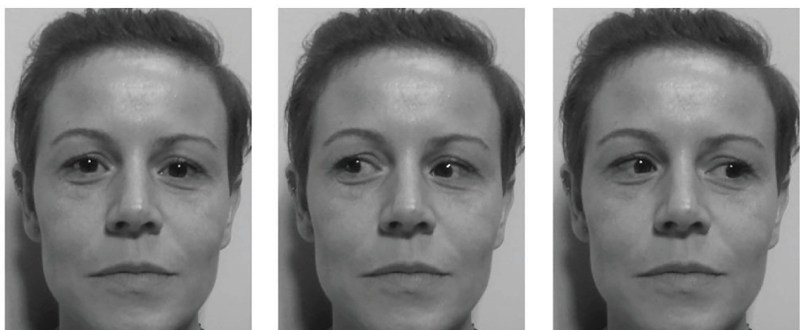
This paper takes its starting point from Lisa Gorton’s poem titled ‘The Book of Revelations’, which responds to the 1952 Sidney Nolan photograph ‘Untitled (Cynthia Nolan with Parasol Mounted on Dead Horse)’. The poem focuses on the particular quality of the smile on Nolan’s face as she sits on the propped-up carcass, clutching her parasol and looking gamely ahead: “I think I know that smile / … / Ashamed of what they’ve asked. Accommodating.” Juxtaposed with this smile are the processes of observation and aversion required in Sidney Nolan as the architect of this scene: “The artist had trained his eye to open and look and shut and turn away.” In this juxtaposition, this poem helps to show the ekphrastic poem’s capacity for capturing the ethics and aesthetics of, in particular, the averted gaze: the gaze which, upon seeing, becomes in some way complicit in the observed act, and chooses to disavow this complicity by looking elsewhere. This poem is particularly pertinent to acts of aversion that generate those moral injuries that don’t have outward consequences. The horse is already dead: sitting on it can’t hurt it, but might it hurt us? In what way could the process of looking away from the unsavoury implications of this act create moral injury in the sitter, the photographer, and, indeed, in the viewer of the photograph? This paper forms part of a larger series of articles on ethics and ekphrasis in twentieth-century poetry, with a particular focus on the moral complications of witnessing. 

Bridget Vincent is a Lecturer in English at the Australian National University. Her first book, Moral Authority in Seamus Heaney and Geoffrey Hill, was published by Oxford University Press in 2022. She writes on modern literature and ethics, and her specific research interests include: public apology in twentieth century writing; ekphrasis; the lyric essay; ecocriticism; and literary attention. She has published on modern poetry in the Modern Language Review, the Australian Humanities Review, Philosophy and Literature, Diogenes and the MLR Yearbook of English Studies. She was recently awarded an AIAS-COFUND II Marie Skłodowska-Curie Fellowship at the Aarhus Institute for Advanced Studies. Prior to this, she received a British Academy Rising Star grant for a project on writing and attention, which considered the role of literature in the age of digital distraction and misinformation. Before coming to the ANU, she taught literary criticism at the universities of Nottingham and Cambridge. 

Rebecca Clode, “Moons will tell terrible truths: (Information) precarity and resistance in Australia’s refugee crisis – a discussion of Behrouz Boochani’s No Friend but the Mountains”

Please join us for the next CuSPP Seminar online on Thursday, 14 March from 1-2pm. Please refer to the CuSPP email or email Wesley.Lim@anu.edu.au for the link.

In a 2012 editorial, Nicholas Ridout and Rebecca Schneider define precarity as “life lived in relation to a future that cannot be propped securely on a past.”1 Responding both literally and immediately to their perspective, this paper considers precarity in the context of Australia’s refugee crisis during the early twenty-first century. Here I explore a current concern around the notion of “information precarity,” specific to the question of asylum seekers’ rights to access digital technologies (particularly mobile phones) in detention centre settings. Questions of information precarity, human vulnerability and “states of precarity associated with the contemporary moment of neoliberalism”2 are focalised through a discussion of Kurdish-Iranian author Behrouz Boochani and his 2018 novel ‘No Friend But the Mountains.’3 Boochani’s work, written during his six-year internment at an Australian offshore processing centre for refugees, draws on his experiences in the precarious space of statelessness. I also explore how, both in and against this asylum setting, Boochani succeeded in publishing his book via SMS communication with his translator and publishers. Drawing on work by Butler,4 Ridout and Schneider,5 and Wall, Campbell and Janbek,6 I interrogate notions of precarity and resistance in light of Boochani’s experience.

Rebecca Clode is the Ethel Tory Lecturer in Drama at the Australian National University. Her current research project for the Freilich Foundation is titled “Performing Resistance: A Study of Literary and Theatrical Interventions into Australia’s Refugee Crisis.” The project, which examines works by Behrouz Boochani and playwright Helen Machalias, aims to better understand the role of literature and performance as vehicles for refugee activism in Australia. Rebecca’s broader research interests include playwriting practices and Australian theatre history. Recent publications include an article co-authored with Julieanne Lamond for Australasian Drama Studies: “Pivoting Resilience: Australian Women Playwrights and the COVID-19 crisis.” Her 2021 monograph is titled Australian Metatheatre on Page and Stage: an exploration of metatheatrical techniques (for Routledge). Rebecca is a PhD graduate of the ANU and also holds an MA in Text and Performance Studies from King’s College and the Royal Academy of Dramatic Art, London. Prior to her academic career, she was a theatre practitioner, and she now maintains her practice locally, for example as dramaturg for playwriting development projects with Canberra’s Street Theatre. She has recently come on board an Associate Co-ordinator for the SLLL’s WellSpring Series with the Street Theatre.

Neil Hogan’s TPR, “Imagining the future: Science and ‘Science (in) Fiction’ in early twentieth century Australian newspapers”

Please join us for the next CuSPP Seminar online on Thursday, 29 February from 1-2pm. Please refer to the CuSPP email or email Wesley.Lim@anu.edu.au for the link.

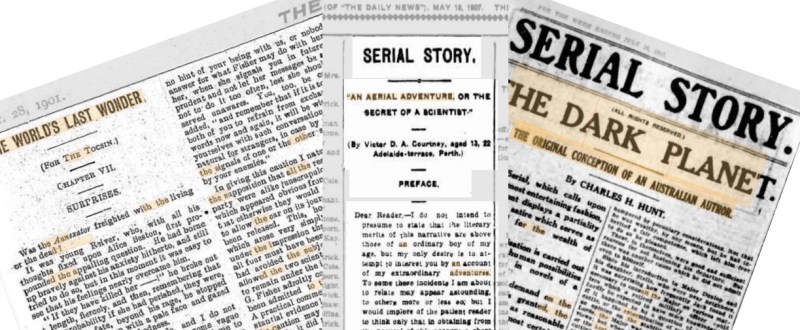
This thesis proposal explores the relationship between science and science fiction in Australian newspapers of the early 20th century through the lenses of digital humanities (DH), genre, science fiction studies (SFS), science and technology studies (STS), and through a creative component in the form of a digital scholarly edition critiquing several early SF works from the period. Through this multidisciplinary approach, and working with fiction in the To Be Continued database and concurrent science articles in the Trove database, the research will contribute to a greater understanding of the role newspaper fiction played in early 20th century Australia, as well as expand on the knowledge domains of science fiction publishing history, socio-political influences on science fiction, the kinds of science featured in fiction at the time, and what it means for Australian cultural identity.

Neil Hogan is a PhD student and researcher at the ANU School of Literature, Languages and Linguistics, and is involved with the ‘to be continued’ project which recovers and makes available lost works of fiction from Australian newspapers. He is also editor and publisher of the semiprozine Alien Dimensions which ‘puts the science back into science fiction.’ He advocates for the low cost republishing of early 20th century science fiction literature so that future readers can rediscover the origins of SF.

Julie Allen (BYU), “Screening Europe in Australasia: Recovering the Silent Era Through Trove”

Please join us for the next CuSPP Seminar in-person on Tuesday, 27 Feb. in the Lady Wilson Room (2.10) in Sir Roland Wilson Building from 4pm-5:30pm

In the era of silent films, when Australian domestic film production fell far below audience demand, French, Danish, and German films were among the most desirable and profitable film imports screened in Australian theaters, but the only surviving record of this European film phenomenon has remained buried in the small print of local newspapers. The digitization of early twentieth century Australian newspapers in the publicly accessible Trove database has made it possible to recover this lost history of German films from Deutsche Bioscop, Messter, Duskes, Greenbaum, and later Ufa that brought stars such as Asta Nielsen, Henny Porten, Madame Saharet, and Emil Jannings into Australian households while their films circulated across the country on urban and rural circuits. This talk, drawn from my recent book Screening Europe in Australasia, explores the extent and significance of the forgotten popularity of German-made films in Australia between 1910 and 1932, documenting the circulation and media coverage of German stars and German stories amid a time of political and personal precarity for Australians of German descent.

Julie Allen is Professor of Comparative Arts and Letters at Brigham Young University. She earned her PhD in Germanic Languages and Literatures from Harvard University. Her research focuses on the construction and dissemination of ideas about cultural identity in 19th and 20th century northern Europe through literature, silent film, migration, and religion. In her 2022 monograph Screening Europe in Australasia: Transnational Silent Film in Australasia (University of Exeter Press), she traces how European and settler colonial cultural identity, film, and migration converged in Australia in the early 20th century, reflecting and informing Australia’s relationship to Europe, Britain, and itself.  

Thomas O. Haakenson (CCA), “The Black Arts Movement & the Western Avant-Garde”

Please join us for the next CuSPP Seminar (taking place both in-person and via zoom)

Surprisingly little attention has been given in discussions about the Western avant garde to the insightful work of the Black Arts Movement in the U.S. in the 1960s and 1970s. Brooklyn-based artist Adam Pendleton and his contemporary Black Dada project, however, make clear the important if underappreciated contributions of the Black Arts Movement to ongoing avant-garde criticality. In redeploying a key text from 1964 – namely, Amiri Baraka’s poem “Black Dada Nihilismus”– Pendleton forces us, in the present moment, to confront the foundational aesthetic, racist, gendered, and sexist assumptions of the Western avant-garde project in its totality.

Thomas O. Haakenson is Associate Professor, History of Art and Visual Culture Program and former Associate Provost as well as Special Assistant to the Provost for Faculty Support at California College of the Arts (CCA). In 2021, Haakenson published the monograph Grotesque Visions: The Science of Berlin Dada, which examines the radical avant-garde interventions of certain Berlin Dada artists as they challenged the questionable practices and evidentiary claims of late-19th- and early-20th-century science. His current book projects include the monograph Decolonizing the European Avant-Garde.

Prof. Penny Edwards (UC Berkeley), “Between the real and the imagined: translating Soth Polin’s L’anarchiste”

Please join us for the next CuSPP Seminar (taking place both in-person and via zoom)

Thursday 9 November, 1-2:30pm, AD Hope Conference Room (see CuSPP email or contact wesley.lim@anu.edu.au for zoom link)

Narrated by a schoolteacher in 1960s Phnom Penh, and a journalist turned taxi-driver in early 1980’s Paris, Soth Polin’s two-part novel L’anarchiste was first published in France in 1981. In his four years in Paris, Virak has made countless stops at the Eiffel Tower, the Arc de Triomphe, or the Sacre-Coeur, but not once has this Parisian landscape surfaced in his sleep. Nor does he dream of Angkor or Khmer monuments: it is the faces of family and friends who appear repeatedly before him: flickering across his windscreen, at the bottom of a beer-glass, or in cigarette smoke, reminding him that he has still not arrived: “Je ne vis dans le réel, ni dans l’imaginaire,” and that he can never escape. “When you lose your country, you lose everything,” Soth Polin explained in a 2004 interview from Long Beach, California, where he now lives: “If you are a writer, you no longer have the echo of your readers.” In this presentation, Penny Edwards discusses the work of translating Soth Polin’s novel, which will appear in full-length translation for the first time with Gazebo Books, Sydney, in 2024.

Penny Edwards is Professor of Southeast Asian Studies at the University of California, Berkeley and the author of Cambodge: The Cultivation of a Nation, 1860-1945. Her translations of Soth Polin have appeared in Mānoa: A Pacific Journal of International Writings, words without borders, and the Mekong Review.

Helen Garner came for tea: the work of the narrative writers at the Royal Commission into Institutional Responses to Child Sexual Abuse

Please join us for the next CuSPP Seminar (taking place both in-person and via zoom)

Thursday 10 August, 1-2pm, AD Hope Conference Room (see CuSPP email or contact wesley.lim@anu.edu.au for zoom link)

A little-known aspect of the Australian child sexual abuse royal commission (2014-2017) is the work done by a team of narrative writers. These writers, of whom I was one, listened to audio recordings of personal testimony given in closed hearings to commissioners, and recomposed what they heard as third person narratives. Nearly 8000 people attended one of these private sessions to share their experience of institutional child sexual abuse with a commissioner, and 3947 of those accounts were transformed into written narratives, presented as an appendix to the commission’s final report and published online.

While personal testimony collected by commissions of inquiry is often presented in the public domain in some mediated form, it is unusual for such testimony to be reworked to the extent that occurred with the narratives produced at the child sexual abuse commission.

This paper examines how the writers understood their role and how this affected their approach to the task. A view of the work as something more than scribing was affirmed by a visit from Helen Garner one day, who brought with her a list of questions that provide the structure for this paper. My discussion brings rare and useful transparency to a process of mediation, exploring questions about the purpose and outcomes of transmitting private testimony to the public sphere in this way.

Sally Zwartz is a PhD student in ANU’s School of Literature, Language and Linguistics. Her project draws on memory studies, narrative studies and cultural theory to examine the child sexual abuse royal commission narratives as a site of memory, an archive, a witnessing project and a collection of individual stories intended to build public understanding of the experience  and impacts of child sexual abuse. She was prompted to examine this subject by her own experience as one of the RCIRCSA writers, and recently held a similar role at the Disability Royal Commission. She also works as an oral historian, currently contracted by the State Library of NSW for an oral history project on children’s literature.

Constructing creativity in the literary and artistic spaces of Boston: Trinity Court 

Please join us for the next CuSPP Seminar (taking place via zoom)

Thursday 21 September, 1-2pm, (see CuSPP email or contact wesley.lim@anu.edu.au for zoom link)

In early twentieth century America, Boston’s Trinity Court was a definitive apartment complex in the new, fashionable, and artistic Back Bay, which was later demolished and virtually forgotten by the twenty-first century, even in some historical maps. Trinity Court had served as a location for meetings of writers and artists and held custom built apartments and rooms for creative practices. Using the Court as a case study this paper explores ideas around the tangibility of creative space and how acts of literary production and creative collaboration can be situated in the field of urban literary studies through the archival study and rediscovery of such locations. 

Bio:

SJ Burton is a research fellow in English at the ANU. She is the Official Historian for the New England Poetry Club in Boston, MA, USA and her research focuses on archival preservation and American poetry with a particular interest in literary communities and notions of place and space in the study of writing. 

Hansard as literary reception: the uses of poetry in Australian political debate

Please join us for the next CuSPP Seminar (taking place both in-person and via zoom)

Thursday 8 June, 1-2pm, AD Hope Conference Room (see CuSPP email or contact julieanne.lamond@anu.edu.au for zoom link).

Julieanne Lamond and Fiannuala Morgan

Hansard – Australia’s record of parliamentary debate – might seem an unlikely site for literary analysis. It is, however, a publisher of original poetry and its criticism, a forum for the performance and citation of poetry, and a complex archive of literary reception in Australia since Federation. When literary works are followed into extra-literary contexts (such as parliament), working assumptions about their status as politically subversive or otherwise come under pressure. Debates in literary studies about the role of critique in the discipline have revealed how common it has been to position the act of reading literature as one of political resistance, or to read a specific work as complicit in or subversive to particular discursive regimes or political positions. In focusing on Hansard in the way we do here, we are reading along, not against, the grain of the imbrication of literature and political power, in a context in which the decisions made in Australia’s Federal parliament had profoundly negative impacts on many people living here. In this paper, we discuss our findings in relation to the uses of poetry in Australian Commonwealth Hansard from 1901 – 1950, focusing on how the work of  one early settler Australian poet-parliamentarian, John Cash Neild, is put to use in Parliamentary speeches as recorded in Hansard.  The performance and discussion of Neild’s poetry in Hansard, in the contexts of the debates in which it is situated, demonstrate the complexity of the racialist attitudes at play in the development of the legislation underpinning what came to be known as the White Australia Policy.

Julieanne Lamond teaches literary studies at Australian National University, and has published essays on literary reception, reading history, gender and literary value, and 19th century and contemporary Australian literature. She is president of the Association for the Study of Australian Literature, and co-editor of the journal Australian Literary Studies. Her recent monograph, Lohrey, on Tasmanian writer Amanda Lohrey, was published by Melbourne University Press in 2022. 

Fiannuala Morgan is a PhD Candidate in Literature at Australian National Unviersity and a Senior Librarian at the National Library of Australia. Her recent publications include the monograph Aboriginal Writers and Popular Fiction: The Literature of Anita Heiss (2021) and the edited collection Black Thursday and Other Lost Australian Bushfire Narratives (2021). 

Chloe Riley, PhD Thesis Proposal Review

Please join us for the next CuSPP Seminar (taking place both in-person and via zoom)

Thursday 25 May, 1-2pm, AD Hope Conference Room (see CuSPP email or contact wesley.lim@anu.edu.au for zoom link).

This creative writing thesis explores the life of famed Australian criminal Frances Knorr, and the politicised representation of deviance and criminality in neo-Victorian literature. This study will consist of two components: a creative component, in the form of a novel, and an accompanying dissertation. The novel will detail the final two years of the life of Frances Knorr, exploring the events surrounding her trial and conviction for the murders of three infants. The narrative will reflect Knorr’s life within the social climate of Melbourne in the early 1890s, and the significance of her trial amidst the influx of infanticides during this period. The accompanying dissertation will explore the construction of nineteenth century deviance and criminality through a disability and crip lens, and its politicised use in neo-Victorian fiction as a mnemonic device to commemorate marginalised histories. A study of Margaret Atwood’s Alias Grace (1996) will explore how Atwood portrays women’s deviance and criminality in terms of disability, and how this portrayal commemorates marginalised women’s history, and the collective trauma of gendered violence. This study will act as a model for reading the way Frances Knorr, and the forgotten history of infanticide and baby-farming in nineteenth century Australia, have been commemorated in two works of fiction: The Notorious Frances Thwaites by Kellinde Wrightson (2014), and The Hanging of Minnie Thwaites by Judith Rodriguez (2012). Finally, this study will place my original novel in the context of existing Knorr literature, exploring how my novel explores Knorr’s perceived deviance and criminality within the social climate of 1890s Australia, and interprets it through the lens of disability, neurodivergence, and trauma.

Chloe Riley (they/she) is a neuroqueer Australian writer based on Wurundjeri country. They hold an honours and a master’s degree in creative writing from Monash University, for which they received first class awards. They were first published in Verge in 2017, for which their short story ‘The Lemon Tree’ was runner-up for the Verge Prize for Prose. Their second short story ‘The Mermaid’ was published in the New Zealand journal Aotearotica in 2018. Their currently unpublished novella Ecdysis, submitted as part of their master’s thesis, is a lesbian narrative loosely based on Charlotte Brontë’s Jane Eyre and Henry Lawson’s ‘The Drover’s Wife’.