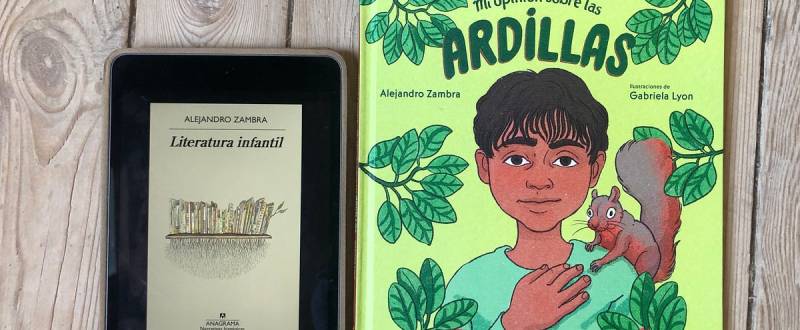
Jéssica Andrade Tolentino and Thomas Nulley-Valdés, “Navigating Boundaries: Intergenerational dynamics and imaginaries of childhood in Alejandro Zambra’s fictions”

Please join us for another CuSPP Seminar in person (BPB W3.03) and online on Thursday, 9 May from 1-2pm. Please refer to the CuSPP email or email Wesley.Lim@anu.edu.au for the link.

Abstract:

As part of doctoral research conducted at the Australian National University, this presentation proposes a comparative analysis of two works by the contemporary Chilean writer Alejandro Zambra. Focusing on close readings of the book of hybrid texts, Literatura infantile (Children’s Literature) (Anagrama, 2023), and his first book for children, Mi opinión sobre las ardillas (My Thoughts on Squirrels) (Ekaré Sur, 2022), we will discuss how Zambra’s literary discourse constructs the categories of childhood and adulthood, and explore the role of intergenerational and transnational dynamics in these works. By analysing the shift in perspective —such as the viewpoint of a recent father or the narrative of a child recounting his father’s fears—, we will address how these relationships are permeated by alterity and otherness. Additionally, the analysis will consider how Zambra employs intergenerational relationships as a fruitful space for reflecting on his own literary work, challenging conventional categories such as genre literature, children’s literature, and adult literature. This paper is part of a transnational study into imaginaries of childhood and parenthood in contemporary Latin American narratives also analysing works by Guadalupe Nettel, Juan Pablo Villalobos, Carolina Sanín, and Valeria Luiselli.

Bios:

Jéssica Mariana Andrade Tolentino is a PhD student at the Australian National University, holding a master’s degree in Children’s Literature, Media and Culture from the University of Glasgow. In 2019, she coedited the book Literatura Infantil: Campo, Materialidade e Produção (Moinhos, 2019). She is cofounder of Colectivo La Lucila, an interdisciplinary group dedicated to the study of children’s media in Latin America.

Dr. Thomas Nulley-Valdés is Lecturer in Spanish Studies at the Australian National University. He is an emerging scholar of World Literature with a focus on Spanish and Latin American literature of the 20th and 21st Centuries. His first monograph is McOndo Revisited (Lexington, 2023), and he is currently preparing an edited volume with Juan Poblete (UC Santa Cruz) titled Chilean Literature as World Literature.

Sophie Tallis (TPR), “Girlhood Bodies on French Screens: From Monstrous Feminine to Liminal Resistance”

Please join us for another CuSPP Seminar in person (BPB W3.03) and online on Thursday, 2 May from 1-2pm. Please refer to the CuSPP email or email Wesley.Lim@anu.edu.au for the link.

Abstract:

Two unanswered questions remain at the centre of the recent influx of French and francophone films about girl protagonists: why has this trend emerged specifically amongst French filmmakers? And, why is the central concern of these films frequently the girlhood body? While scholarship engages with the depictions of girlhood in such films, there has yet to be a study that engages specifically with the ways that these filmmakers render the girlhood body as a site of Frenchness.

In this seminar I will present my thesis proposal review for my research entitled Girlhood Bodies on French Screens: From Monstrous Feminine to Liminal Resistance. My thesis aims to address this growing body of French filmography which centres girl protagonists and understand how these films and filmmakers portray girlhood as a culturally informed phenomenological experience, through the lens of French republican universalist identity politics. By examining recent films such as Junior (Julia Ducournau, 2011), Bang Gang (une histoire d’amour moderne)/Bang Gang (A Modern Love Story) (Eva Husson, 2015), L’Événement/Happening (Audrey Diwan, 2021), 17 filles/17 Girls (Delphine and Muriel Coulin, 2011), and La Vie d’Adèle – Chapiters 1 & 2/Blue is the Warmest Colour (Abdellatif Kechiche, 2013), I contend these films suggest that bodily actions such as puberty, sexual awakenings, pregnancy and abortion place the characters on the threshold of girlhood and womanhood—a liminal space in which resistance against social norms can occur. Through my research, I will interrogate what these depictions of girlhood bodies reveal about acceptable versions of French femininity and to what extent the adolescent bodily rebellions celebrated in these films are meaningful challenges to these norms, or instead reinforce that the end of adolescence must be accompanied by a return to social acceptability.

Sophie Tallis is a PhD student in Screen Studies at the Australian National University. Her research focuses on  examines francophone girlhood cinema with a focus on transnational films. Her work has been published in The Burgmann Journal and Sacreblue!, with forthcoming publications in The Australian Journal for French Studies and French Screen Studies. She has presented her work in academic and public circles including the Australian Society for French Studies Conference, the Alliance Française French Film Festival and the National Film and Sound Archive.

Zach Karpinellison (Exit Seminar), “Versions & The NFSA“

Please join us for the next CuSPP Seminar in person (BPB W3.03) and online on Wednesday, 24 April from 5:30-6:30pm. Please refer to the CuSPP email or email Wesley.Lim@anu.edu.au for the link.

Abstract:

What version of Starstruck have you seen? Do you remember the cut of Bliss where Harry tells the story of Little Titch? Was it possible for you to see Wake in Fright between 1971 and 2009?

These questions stem from a reality that is often overlooked by academic study of film archives. We understand that these institutions hold films in their collections, but the truth is much richer and more complex. In fact, organisation like the National Film and Sound Archive (NFSA) here in Canberra, hold not just these films, but multiple versions of each of these films. This can mean any number of things. Sometimes the versions refer to different cuts. Sometimes they refer to different formats or to censored copies. And sometimes these versions are new — they are created by the archive as part of a restoration initiative, or simply as a byproduct of practices of preservation and digitisation.

The film archive is not typically recognised as a producer of media. Instead, standard definitions associate archival practice with the maintenance and protection. As such it is understood as a repository – a place where films are held, cared for, made available for examination and more broadly accessed but not created. In this exit seminar, I reflect on the PhD I began in 2021 that takes as its subject both these film-versions and the NFSA as an institution. I argue that the NFSA is a kind of production culture, not unlike Hollywood or the Australian film industry. It is precisely the NFSA’s production of restorations and film-versions that prompts my inquiry.

In this seminar, I’ll provide an overview of my research thus far, and offer some examples that demonstrate a response to the two questions my thesis poses. Firstly, what are the implications of using versions of films to produce restorations for the public? And secondly, I ask how do the staff of the NFSA understand and theorise their relationship to the preserved materials in the collection? Both of these research questions allow me to reflect on the cultural and political status of the archive at the time of these new productions.

In response to these questions I have devised two connected methodological strategies: versional analysis and interviews with relevant stakeholders. This exit seminar provides an opportunity for me to offer some of my findings, as well as demonstrate the ways that my methodology opens up avenues for further research.

Bio:

Zach Karpinellison is an interdisciplinary PhD candidate at the Australian National University. His research takes place at the intersection of museum and media studies. He is in the final year of his doctoral program and completing work on his thesis titled Versions and The NFSA.

Veli-Matti Pynttäri (University of Eastern Finland), “Lost and Found in the 19th Century Finnish Literature. History, Bibliographies and Digital Methods”

Please join us for the next CuSPP Seminar in person (BPB W3.03) and online on Thursday, 28 March from 1-2pm. Please refer to the CuSPP email or email Wesley.Lim@anu.edu.au for the link.

Abstract: In the talk I will give a brief a presentation of our consortium project Digital History for Literature in Finland 1809-1917 (2022-2026) funded by the Academy of Finland. The goal of the project is to produce new information about 19th century fiction in Finland by using digital methods and digital materials. As we know, no bibliography or presentation of literary history can be fully complete or transparent regarding the literature that was actually written, published and read in the past. In my talk I will focus on two intertwined areas that contribute to this gap between the past and the information we now have. First, I will sketch a history of how Finnish National Collection and National Bibliography was formed in the 19th century and highlight how precarious this history was. Second, I will detail our method of retrieving previously unknown or omitted literature from Finnish National Bibliography database and point to the difficulties both with the bibliographic metadata and geographically and culturally diverse reality in the 19th century Finland.

Dr. Veli-Matti Pynttäri is a researcher in the consortium project Digital History for Literature in Finland 1809-1917 (2022-2026) funded by the Academy of Finland, which consists of the Department of Literature at the University of Eastern Finland (PI Prof. Kati Launis), University of Turku Data Science (PI Prof. Leo Lahti) and the National Library (PI FT Osma Suominen). The goal of the project is to produce new information about Finnish 19th century fiction by using digital methods and digital materials. Pynttäri has done his dissertation on the cultural critical production of T. Vaaskivi (1912-1942) and in his post-doctoral research he has done research on essay literature from the perspective of both literary genre and literary history. Currently, in addition to digital methods, he is particularly interested in questions related to reading, both in the modern world and in the history of books. He has also taught Finnish language and literature in high school, and for several years he has been an associate member of the Matriculation Examination Board. In 2018, he was a member of the Runeberg Award selection committee and the following year a member of the award committee. In 2022, he was the chairman of the selection board for the Finlandia Prize for fiction.

Bridget Vincent, “‘To open and look and shut and turn away’: Ekphrasis and the Averted Gaze.”

Please join us for the next CuSPP Seminar in person (BPB W3.03) and online on Thursday, 21 March from 1-2pm. Please refer to the CuSPP email or email Wesley.Lim@anu.edu.au for the link.

This paper takes its starting point from Lisa Gorton’s poem titled ‘The Book of Revelations’, which responds to the 1952 Sidney Nolan photograph ‘Untitled (Cynthia Nolan with Parasol Mounted on Dead Horse)’. The poem focuses on the particular quality of the smile on Nolan’s face as she sits on the propped-up carcass, clutching her parasol and looking gamely ahead: “I think I know that smile / … / Ashamed of what they’ve asked. Accommodating.” Juxtaposed with this smile are the processes of observation and aversion required in Sidney Nolan as the architect of this scene: “The artist had trained his eye to open and look and shut and turn away.” In this juxtaposition, this poem helps to show the ekphrastic poem’s capacity for capturing the ethics and aesthetics of, in particular, the averted gaze: the gaze which, upon seeing, becomes in some way complicit in the observed act, and chooses to disavow this complicity by looking elsewhere. This poem is particularly pertinent to acts of aversion that generate those moral injuries that don’t have outward consequences. The horse is already dead: sitting on it can’t hurt it, but might it hurt us? In what way could the process of looking away from the unsavoury implications of this act create moral injury in the sitter, the photographer, and, indeed, in the viewer of the photograph? This paper forms part of a larger series of articles on ethics and ekphrasis in twentieth-century poetry, with a particular focus on the moral complications of witnessing. 

Bridget Vincent is a Lecturer in English at the Australian National University. Her first book, Moral Authority in Seamus Heaney and Geoffrey Hill, was published by Oxford University Press in 2022. She writes on modern literature and ethics, and her specific research interests include: public apology in twentieth century writing; ekphrasis; the lyric essay; ecocriticism; and literary attention. She has published on modern poetry in the Modern Language Review, the Australian Humanities Review, Philosophy and Literature, Diogenes and the MLR Yearbook of English Studies. She was recently awarded an AIAS-COFUND II Marie Skłodowska-Curie Fellowship at the Aarhus Institute for Advanced Studies. Prior to this, she received a British Academy Rising Star grant for a project on writing and attention, which considered the role of literature in the age of digital distraction and misinformation. Before coming to the ANU, she taught literary criticism at the universities of Nottingham and Cambridge. 

Rebecca Clode, “Moons will tell terrible truths: (Information) precarity and resistance in Australia’s refugee crisis – a discussion of Behrouz Boochani’s No Friend but the Mountains”

Please join us for the next CuSPP Seminar online on Thursday, 14 March from 1-2pm. Please refer to the CuSPP email or email Wesley.Lim@anu.edu.au for the link.

In a 2012 editorial, Nicholas Ridout and Rebecca Schneider define precarity as “life lived in relation to a future that cannot be propped securely on a past.”1 Responding both literally and immediately to their perspective, this paper considers precarity in the context of Australia’s refugee crisis during the early twenty-first century. Here I explore a current concern around the notion of “information precarity,” specific to the question of asylum seekers’ rights to access digital technologies (particularly mobile phones) in detention centre settings. Questions of information precarity, human vulnerability and “states of precarity associated with the contemporary moment of neoliberalism”2 are focalised through a discussion of Kurdish-Iranian author Behrouz Boochani and his 2018 novel ‘No Friend But the Mountains.’3 Boochani’s work, written during his six-year internment at an Australian offshore processing centre for refugees, draws on his experiences in the precarious space of statelessness. I also explore how, both in and against this asylum setting, Boochani succeeded in publishing his book via SMS communication with his translator and publishers. Drawing on work by Butler,4 Ridout and Schneider,5 and Wall, Campbell and Janbek,6 I interrogate notions of precarity and resistance in light of Boochani’s experience.

Rebecca Clode is the Ethel Tory Lecturer in Drama at the Australian National University. Her current research project for the Freilich Foundation is titled “Performing Resistance: A Study of Literary and Theatrical Interventions into Australia’s Refugee Crisis.” The project, which examines works by Behrouz Boochani and playwright Helen Machalias, aims to better understand the role of literature and performance as vehicles for refugee activism in Australia. Rebecca’s broader research interests include playwriting practices and Australian theatre history. Recent publications include an article co-authored with Julieanne Lamond for Australasian Drama Studies: “Pivoting Resilience: Australian Women Playwrights and the COVID-19 crisis.” Her 2021 monograph is titled Australian Metatheatre on Page and Stage: an exploration of metatheatrical techniques (for Routledge). Rebecca is a PhD graduate of the ANU and also holds an MA in Text and Performance Studies from King’s College and the Royal Academy of Dramatic Art, London. Prior to her academic career, she was a theatre practitioner, and she now maintains her practice locally, for example as dramaturg for playwriting development projects with Canberra’s Street Theatre. She has recently come on board an Associate Co-ordinator for the SLLL’s WellSpring Series with the Street Theatre.

Neil Hogan’s TPR, “Imagining the future: Science and ‘Science (in) Fiction’ in early twentieth century Australian newspapers”

Please join us for the next CuSPP Seminar online on Thursday, 29 February from 1-2pm. Please refer to the CuSPP email or email Wesley.Lim@anu.edu.au for the link.

This thesis proposal explores the relationship between science and science fiction in Australian newspapers of the early 20th century through the lenses of digital humanities (DH), genre, science fiction studies (SFS), science and technology studies (STS), and through a creative component in the form of a digital scholarly edition critiquing several early SF works from the period. Through this multidisciplinary approach, and working with fiction in the To Be Continued database and concurrent science articles in the Trove database, the research will contribute to a greater understanding of the role newspaper fiction played in early 20th century Australia, as well as expand on the knowledge domains of science fiction publishing history, socio-political influences on science fiction, the kinds of science featured in fiction at the time, and what it means for Australian cultural identity.

Neil Hogan is a PhD student and researcher at the ANU School of Literature, Languages and Linguistics, and is involved with the ‘to be continued’ project which recovers and makes available lost works of fiction from Australian newspapers. He is also editor and publisher of the semiprozine Alien Dimensions which ‘puts the science back into science fiction.’ He advocates for the low cost republishing of early 20th century science fiction literature so that future readers can rediscover the origins of SF.

Julie Allen (BYU), “Screening Europe in Australasia: Recovering the Silent Era Through Trove”

Please join us for the next CuSPP Seminar in-person on Tuesday, 27 Feb. in the Lady Wilson Room (2.10) in Sir Roland Wilson Building from 4pm-5:30pm

In the era of silent films, when Australian domestic film production fell far below audience demand, French, Danish, and German films were among the most desirable and profitable film imports screened in Australian theaters, but the only surviving record of this European film phenomenon has remained buried in the small print of local newspapers. The digitization of early twentieth century Australian newspapers in the publicly accessible Trove database has made it possible to recover this lost history of German films from Deutsche Bioscop, Messter, Duskes, Greenbaum, and later Ufa that brought stars such as Asta Nielsen, Henny Porten, Madame Saharet, and Emil Jannings into Australian households while their films circulated across the country on urban and rural circuits. This talk, drawn from my recent book Screening Europe in Australasia, explores the extent and significance of the forgotten popularity of German-made films in Australia between 1910 and 1932, documenting the circulation and media coverage of German stars and German stories amid a time of political and personal precarity for Australians of German descent.

Julie Allen is Professor of Comparative Arts and Letters at Brigham Young University. She earned her PhD in Germanic Languages and Literatures from Harvard University. Her research focuses on the construction and dissemination of ideas about cultural identity in 19th and 20th century northern Europe through literature, silent film, migration, and religion. In her 2022 monograph Screening Europe in Australasia: Transnational Silent Film in Australasia (University of Exeter Press), she traces how European and settler colonial cultural identity, film, and migration converged in Australia in the early 20th century, reflecting and informing Australia’s relationship to Europe, Britain, and itself.  

Thomas O. Haakenson (CCA), “The Black Arts Movement & the Western Avant-Garde”

Please join us for the next CuSPP Seminar (taking place both in-person and via zoom)

Surprisingly little attention has been given in discussions about the Western avant garde to the insightful work of the Black Arts Movement in the U.S. in the 1960s and 1970s. Brooklyn-based artist Adam Pendleton and his contemporary Black Dada project, however, make clear the important if underappreciated contributions of the Black Arts Movement to ongoing avant-garde criticality. In redeploying a key text from 1964 – namely, Amiri Baraka’s poem “Black Dada Nihilismus”– Pendleton forces us, in the present moment, to confront the foundational aesthetic, racist, gendered, and sexist assumptions of the Western avant-garde project in its totality.

Thomas O. Haakenson is Associate Professor, History of Art and Visual Culture Program and former Associate Provost as well as Special Assistant to the Provost for Faculty Support at California College of the Arts (CCA). In 2021, Haakenson published the monograph Grotesque Visions: The Science of Berlin Dada, which examines the radical avant-garde interventions of certain Berlin Dada artists as they challenged the questionable practices and evidentiary claims of late-19th- and early-20th-century science. His current book projects include the monograph Decolonizing the European Avant-Garde.

Prof. Penny Edwards (UC Berkeley), “Between the real and the imagined: translating Soth Polin’s L’anarchiste”

Please join us for the next CuSPP Seminar (taking place both in-person and via zoom)

Thursday 9 November, 1-2:30pm, AD Hope Conference Room (see CuSPP email or contact wesley.lim@anu.edu.au for zoom link)

Narrated by a schoolteacher in 1960s Phnom Penh, and a journalist turned taxi-driver in early 1980’s Paris, Soth Polin’s two-part novel L’anarchiste was first published in France in 1981. In his four years in Paris, Virak has made countless stops at the Eiffel Tower, the Arc de Triomphe, or the Sacre-Coeur, but not once has this Parisian landscape surfaced in his sleep. Nor does he dream of Angkor or Khmer monuments: it is the faces of family and friends who appear repeatedly before him: flickering across his windscreen, at the bottom of a beer-glass, or in cigarette smoke, reminding him that he has still not arrived: “Je ne vis dans le réel, ni dans l’imaginaire,” and that he can never escape. “When you lose your country, you lose everything,” Soth Polin explained in a 2004 interview from Long Beach, California, where he now lives: “If you are a writer, you no longer have the echo of your readers.” In this presentation, Penny Edwards discusses the work of translating Soth Polin’s novel, which will appear in full-length translation for the first time with Gazebo Books, Sydney, in 2024.

Penny Edwards is Professor of Southeast Asian Studies at the University of California, Berkeley and the author of Cambodge: The Cultivation of a Nation, 1860-1945. Her translations of Soth Polin have appeared in Mānoa: A Pacific Journal of International Writings, words without borders, and the Mekong Review.