
Fabricio Tocco, ‘Thrilling Gringos:  Americans, Europeans and the Secret Liaisons between Latin America and the Thriller’

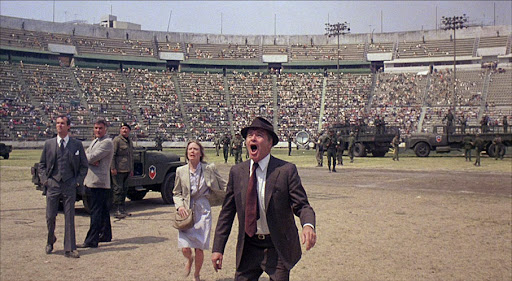
Image Credit: Costa-Gavras, Missing (1982).

Please join us for a CuSPP Seminar in person (BPB W3.03) and online on Thursday 23 October from 1-2. Please refer to the CuSPP email or email Thomas.Nulley-Valdes@anu.edu.au for the link.

ABSTRACT: The secret liaisons between Latin America and the thriller are older than they seem. Following the southbound journey of gringos—Early Modern Southern European colonisers, nineteenth-century American and British swindlers, Nazi Germany spies, Cold War CIA agents—this presentation traces how the region became inseparable from the genre long before local authors and filmmakers claimed it as their own. The 1906 appearance of the word “thriller” attached to Roy Rockwood’s Jack North’s Treasure Hunt: Daring Adventures in South America, an American adventure novel set in Chile and Peru, is no accident: Latin America’s exotic and dangerous fauna, along with its civil wars and deceptive landscapes, were already paving the way for the genre. An excerpt from the first chapter of my forthcoming book Precarious Secrets: A History of the Latin American Political Thriller (Austin: University of Texas Press, 2025), this presentation examines how Rockwood’s novel and Argentine-English Guillermo Enrique Hudson’s The Purple Land that England Lost (1885) shaped the work of Fritz Lang, Alfred Hitchcock, and Costa-Gavras: the American and European political thriller set in Latin America, an embryonic but key stage in the history of the genre in the region. This presentation argues that what looks like imperialistic appropriation is a secret liaison, where American and European models become difficult to disentangle from Latin America’s later forays into the thriller, and from the fact that genres can always be re-appropriated by those represented within them.

SPEAKER BIO: Dr Fabricio Tocco is a Lecturer in Spanish at SLLL. He is the author of the novel Parece diciembre (2025, Equidistancias) and two books, Latin American Detectives against Power (Lexington, ICFA Book Prize 2022) and Precarious Secrets (2025, University of Texas Press), which inspired the documentary Secretos Precarios (SBS on Demand, 2025).

Elizabeth Keen, “Desperately mortal in the moated grange: a cosmological view of Shakespeare’s Measure for Measure”

Image credit: Image of the world, theatre of the world: Creation, from Hartmann Schedel, Das Buch der

Croniken (Nuremberg 1493). Paris, BnF, Rés. G. 505.

Please join us for a CuSPP Seminar in person (BPB W3.03) and online on Thursday 9 October from 1-2. Please refer to the CuSPP email or email Thomas.Nulley-Valdes@anu.edu.au for the link.

ABSTRACT: In this work-in-progress paper I discuss the play Measure for Measure by William Shakespeare, first performed in 1604 in front of the new Protestant King James the First and Sixth. The critical literature on the play over the last three centuries has included discussion of the ways it acknowledges James’s documented personality and interests, in addition to much negative comment on perceived problems of genre, character, ethics and lack of clear dénouement. While it has its proponents and there have no doubt been successful productions it seems that Measure for Measure continues to present a challenge to performers, audiences and readers and is open to different interpretations as cultural perspectives alter.

I’m proposing that we use our long historical hindsight to imagine how it could have been viewed or heard by an early-modern, mainly Protestant audience through the lens of the cosmological and eschatological world-view of the time and associated forms of discourse, in order to discover possible interpretations appropriate to that time. In particular I’m examining whether our modern awareness of the literary genre of imago mundi, inherited by an early-modern, post-Reformation public, can help us to discern layers of allusion more available to them than to us. I propose that Measure for Measure could have drawn audiences’ attention to what had long been taught about the Christian cosmos and their place in it by staging highly problematic social and moral situations in an imagined city very much like – and also very unlike – their own, and encouraging a sense of involvement as compassionate observers of those situations.

SPEAKER BIO: I took my Honours Degree in English Language and Literature at Bristol University in 1961-4, but it was not until 1994 and a new life in Australia that I was able to join the Masters program in the History Department at ANU, followed by a Doctorate completed in 2003 under the supervision of Dr John Tillotson. The subject was the long reception history of the 13thc Franciscan compilation of knowledge later known as ‘On the Properties of Things’. During this time I enjoyed contact with students and colleagues as a tutor and lecturer in several medieval history courses. Thanks to a Visiting Fellowship in the same department I was able to publish articles arising from my research, in addition to The Journey of a Book: Bartholomew the Englishman and the Properties of Things (2007, ANU Epress), and a chapter ‘Shifting Horizons: the medieval compilation of knowledge as mirror of a changing world’ in J.König and G.Woolf, Encyclopaedism from Antiquity to the  Renaissance (2013, Cambridge University Press). After some years of living in the bush I am now an independent scholar affiliated with CEMS (my thanks to Dr Rosalind Smith) and have resumed research that combines my interests in medieval history and early-modern literature.

Confirmation Presentation – Dylan Chng, “Transhistorical Digital Literary Aesthetics: Hypermediality On and Before Computer Screens”

A digital collage comprising elements from: a miniature from the British Library; the videogame PentimentAleph Null 3.0 by Brad Pasutti and Karl Kempton

Please join us for a CuSPP Confirmation Presentation in person (BPB W3.03) and online on Thursday 21 August from 1-2pm. Please refer to the CuSPP e-mail or e-mail Thomas.Nulley-Valdes@anu.edu.au for the link.

Abstract:

Electronic literature (e-lit) and its digital literary aesthetics have been around since at least the 1980s but literary criticism still perceives them as new. This newness is typically conceived in terms of e-lit’s radical departure from literature’s mainstay of print—or else e-lit represents the remediation and renovation of bibliographical forms. In turn, overemphases on e-lit’s newness have produced criticism preoccupied with distinguishing screens from pages and questioning whether literature’s foundational paradigms can adequately address an apparently unprecedented digital literary aesthetics.

My thesis adopts, instead, a transhistorical approach to digital literary aesthetics that identifies its possibilities throughout literature’s chiefly bibliographical annals. In this seminar, I describe my transhistorical approach via the deconstruction of digital literary aesthetics as the hypermedialityof literary artefacts that demand the interpretation of not just verbal but multiple, intricately interoperating modes of aesthetic communication. As such, phenomena of hypermediality are neither inherently contemporary nor contingent upon digital media but rather conditioned to seemdigital. 

I engage affordance theory to disentangle contemporary phenomena of hypermediality from their conditional digitality. Affordance theory calls attention to how subjects, artefacts, and the contexts of their encounters co-constitute each other. As regards digital literary aesthetics, critics encounter e-lit in the context of the Digital Age and thus, I argue, tend to construe phenomena of hypermediality as uniquely digital because digital technoculture makes hypermediality not only more readily available but also possible to name. Understanding how digital media afford hypermediality and condition its digitality means conversely learning to recognise the diverse presence of so-called digital literary aesthetics in historic bibliographical texts from before computer screens. I compare Jon Bois’s 17776 (2017) to William Blake’s Songs of Innocence (1789) and present my thesis’s four case studies on various phenomena of hypermediality to show how some historic forms of literature might also be “digital.”

Speaker Bio:

Dylan Chng is a PhD student at ANU’s School of Literature, Languages and Linguistics, researching intersections between technology, experience, and thought in media aesthetics and the digital humanities. He will be presenting at the Humanities meets AI (Singapore) and Digital Humanities Australasia conferences (Canberra) in late 2025, and co-teaches a forthcoming MOOC on Southeast Asia’s transcultural art histories by the National University of Singapore. He also holds an MPhil in Digital Humanities from the University of Cambridge.