HRC Symposium: Assessing Research Impact Across the Humanities

A Symposium in the Humanities Research Centre, ANU

Wednesday 2 November, 9am – 12 midday, HRC Conference Room, A. D. Hope Bldg

Understanding research impact is now a priority for scholars in Australian universities, since the Australian Research Council is committed to assessing the public outcomes of university research. What will the assessment of research impact look like? And how might researchers approach research projects with integrity, such that their research is both intellectually rigorous and legible to an audience beyond their disciplines?

This symposium brings researchers from the UK with experience assessing and writing impact case studies to the ANU to discuss how research with impact has been produced and measured in England, and how Australian researchers can best position themselves to communicate their research to the public.

Speakers include Professor Ann Heilmann, Professor Maria Delgado and Professor Malcolm Gillies AM.

Register: https://publicknowledgeanu.eventbrite.com.au
Contact: lucy.neave@anu.edu.au for details.
Literature and Politics: A Public Talk by Amanda Lohrey

Literature and Politics: A Public Lecture by Amanda Lohrey

Thursday 20 October, 5.30 pm, Theatrette, Sir Roland Wilson Bldg

H.C. Coombs Fellow Amanda Lohrey will talk about whether fiction can make an effective political intervention. If the novel comes after the event and is a chronicle of, or argument with, a political event, does that mean that fiction is unable to shape such occurrences? Could fiction have a different role in more repressive societies, and achieve a form of symbolic power as a gesture of resistance, or fortify the morale of activists on the ground? To quote Marcuse, art by itself can never achieve transformation, but it can under certain circumstances ‘free the perception and sensibility needed for the transformation’. Amanda Lohrey’s lecture will look at the role of fiction and its ability to influence the political sphere.

Amanda Lohrey is the author of the acclaimed novels Camille’s Bread, Vertigo and The Morality of Gentlemen, as well as the award-winning short story collection Reading Madame Bovary. She has written two Quarterly Essays: ‘Groundswell’ and ‘Voting for Jesus’. In 2012 she was awarded the Patrick White Literary Award.

Enquiries: lucy.neave@anu.edu.au

Lunchtime Seminar: Gemma King on Contemporary French Cinema

Contemporary French cinema and the langue de passage

Thursday 13 October, 1pm Milgate Room, AD Hope Bldg, SLLL

Since the advent of sound cinema, the French language has been used to bolster conceptions of national identity in French film. Yet as multilingualism has become increasingly prominent in cinema, the representation of the French language has begun to shift. Having once occupied a hegemonic position as the sole language of value in most French films, French is being increasingly decentred to make way for a multitude of other languages, ranging from rival lingua francas like English to regional languages like Corsican and the languages of former French colonies, such as Arabic, Wolof and Bambara.

This paper proposes a new term for understanding the role national languages can play in film, using vocabulary from Abdellatif Kechiche’s 2007 film La Graine et le mulet to construct the idea of the langue de passage; a language of ‘passing’ or ‘passage’. In contemporary films about migration like Dheepan (Jacques Audiard, 2015) and Welcome (Philippe Lioret, 2009), French is a langue de passage; a language of critical, but temporary, value. These films thus resituate discourse on language and identity in French cinema and are responsive to the world within, across and beyond French borders.

Gemma King joined the ANU as Lecturer in French Studies in July 2016. Her research explores the relationship between language use and social power in French and Francophone cinema. She completed her PhD as a Cotutelle degree at the University of Melbourne and the Sorbonne Nouvelle: Paris 3 in 2015 and her book Decentring France: Multilingualism and Power in Contemporary French Cinema is forthcoming with Manchester University Press.

Theory Reading Group: readings and next meeting (4-6pm Friday 7 October)

Russell Smith’s TRG update, including details about readings for the next meeting:

We had a great session last week, dwelling at length on the various lines of inquiry suggested by William Davies’s incredibly compact and lucid essay, and covering all the ills of neoliberalist emotional life, from anxiety inducing children’s advertising to the deadening upbeatness of social media, from the hidden kinds of emotional labour to those horrible people on reality tv that you know you are being manipulated to hate. So much so, in fact, that we didn’t get around to discussing Illouz at all. However, we were agreed that discussing Cold Intimacies would be a VERY GOOD THING, and that we would do it in the next session, focussing on the first chapter ‘The Rise of Homo Sentimentalis’ and the third chapter ‘Romantic Webs’, in which she tests out her theory of a confluence between managerial theory, therapeutic discourse and liberal feminism in the twentieth-century’s invention of a new kind of entrepreneurial rationalist approach to one’s own emotional well-being. Sadly David Bissell won’t be with us this time, but if we go as slowly as last time, we’ll still be discussing Eva Illouz a fortnight later…

4-6pm Friday 7 October, in the first-floor common room, AD Hope room 113.


Lunchtime Seminar: Piera Carroli on Marilù Oliva’s Warrior Trilogy

La Guerrera – Marilù Oliva’s Warrior Trilogy

Thursday 6 October, 1pm Milgate Room, AD Hope Bldg, SLLL

Recognised as the Italian capital of noir, Bologna, still produces striking crime writers. Oliva belongs to the generation following Grazia Verasani and Carlo Lucarelli. She embodies today’s noir Bologna, at once continuing and revolutionising crime literature with the Trilogia della Guerrera [Woman Warrior Trilogy], the first multilingual transcultural series set in a refreshingly new Latin Bologna. The trilogy’s titles, ¡Tu la pagaràs! (2011) [You will pay for it], Fuego (2012) [Fire] and Mala suerte (2013) [Misfortune] and all salsa songs are in Spanish. Oliva transcends regional and national borders while continuing Italian crime fiction’s engagement with social issues: uncertain working conditions, immigration and violence against women. Although Oliva’s eclectic approach to genre, structure, style and content is not unusual in noir, what stands out, besides the unprecedented portrayal of Latin Bologna, is the choice of protagonist, languages, and investigative approach. Oliva’s knowledge of Spanish and Portuguese languages and cultures, and world mythology, along with Classical literature, including Dante’s Divine Comedy, allows her to add an unusual depth and breadth to her crime fiction. The trilogy constitutes an innovative noir itinerary into mezcla—an explosive anthropological mix—both material and esoteric, into Latin American music and dance, ancient magical Bononia besides present metropolitan Bologna. My research aims to bring Oliva’s work to the attention of academic communities by highlighting the innovative energy she brings to noir.

Piera Carroli is Senior Lecturer and Convener of the Italian Studies Program in SLLL. She has published on literature, applied linguistics and pedagogy. Her most recent work is on the representation of otherness and mezcla in Italian noir. She was interviewed on SBS Italian Radio about her research on Marilù Oliva.

ANU’s Theory Reading Group

ANU’s Theory Reading Group (TRG) is on this Friday 2nd September, 4-6pm in the AD Hope Common Room (ANU), first floor above the Classics Museum.

The texts under discussion are two recent articles from New Left Review, Luc Boltanski & Arnaud Esquerre’s “The Economic Life of Things” and Marco D’Eramo’s “Dock Life”.

There are a number of suggestions on the table for coming weeks, continuing the vein of analyses dealing with the affective dimensions of late capitalism: a chapter or two from Eva Illouz’s Cold Intimacies: The Making of Emotional Capitalism; Fredric Jameson’s ‘controversial manifesto’ An American Utopia, and/or, William Davies’ essay (also from NLR), ‘The Political Economy of Unhappiness’; or even, an oldie but a goodie, Jacques Attali’s Noise. We’ll decide on Friday.

Hope to see you there & feel free to bring drinks, snacks, friends, fellow travellers, shipping containers packed with luxury goods, etc.

Russell Smith

Ps. Please do get in touch if you want to join TRG. We’ll sign you up to our mailing list and link you to the dropbox file of weekly readings.

Lunchtime Seminar: Kate Flaherty on “Richard III” and the colonial theatre public

On the edge of chaos: Richard III and the colonial theatre public

Thursday 1 September, 1pm Milgate Room, AD Hope Bldg, SLLL

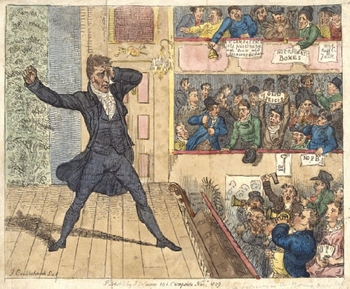
On 26 December 1833, the first licenced theatre in New South Wales offered its first Shakespeare play—Colley Cibber’s adaptation of Richard III. The event entailed a riot in which the actor playing Gloucester hurled an audience member from the stage. Using insights drawn from scholarship on the Covent Garden ‘Old Price Riots’ in 1809, this paper will investigate the Sydney Theatre Royal’s 1833 disturbance as an indicative phase in the development of a colonial theatre public. Thirty years after this vexed beginning, majestic theatre venues hosted international stars throughout Australia’s major cities. What constituted this rapid cultural transformation? This paper demonstrates how the press, satire, and travesty, were active agents in the process through their performative negotiation of the penal colony’s troubled relationship with Shakespeare. Central to the narrative is Richard III, a drama of disrupted authority which (with Othello) was, uncannily, the most popular play on the colonial Australian stage.

Kate Flaherty is a lecturer in English and Drama in SLLL. Her monograph Ours as we play it: Australia plays Shakespeare (UWAP, 2011) examined three plays in performance in contemporary Australia. More recent work investigates Shakespeare on the colonial stage and the public interplay of the dramas with education, imperial politics and sectarian friction. Her work has been published in Contemporary Theatre Review, Australian Studies and Shakespeare Survey.