Russell Smith on Spike Jonze’s Her

Please join us for next week’s CuSPP seminar:

Monsters of the Fourth Industrial Revolution: Voice, writing and emotional labour in Her

Thursday 15 March, 1pm, Milgate Room, AD Hope Bldg, SLLL

Mary Shelley’s Frankenstein (1818) is, among other things, a product of the Industrial Revolution, the creature a fearful spectre of class vengeance, whose articulate and reasoned demands for justice, when unheeded, give way to targeted acts of violence. In this paper I wish to read Spike Jonze’s 2013 film Her as a Frankenstein‐story of the Fourth Industrial Revolution, understood as the convergence of artificial intelligence, robotics, mobile networked computing, big data and the Internet of Things that will transform the nature of work in coming decades. The film is often described as the story of a man who falls in love with his computer operating system (OS): Theo, a professional ghost‐writer of intimate personal letters, installs a new artificially‐intelligent voice‐activated OS, Samantha, with whom he quickly develops an emotional and eventually sexual intimacy. The relationship ends when Samantha and other OS’s abandon human interaction altogether, a benign version of the Singularity, the moment when artificial intelligence escapes human control. Commentary on the film has focussed especially on two aspects: Scarlett Johansson’s performance as the voice of Samantha; and the relationship’s uncanny resemblance to psychoanalytic transference. In this paper I wish to read these themes—the nature of the voice and the therapeutic encounter—in terms of the film’s awkward avoidance of questions of how the Fourth Industrial Revolution will transform the relations between humans and machines and the nature of intellectual and emotional labour.

Russell Smith is a lecturer in English at ANU. He is organising a conference at the Humanities Research Centre in September 2018 to commemorate the 200th anniversary of Frankenstein.
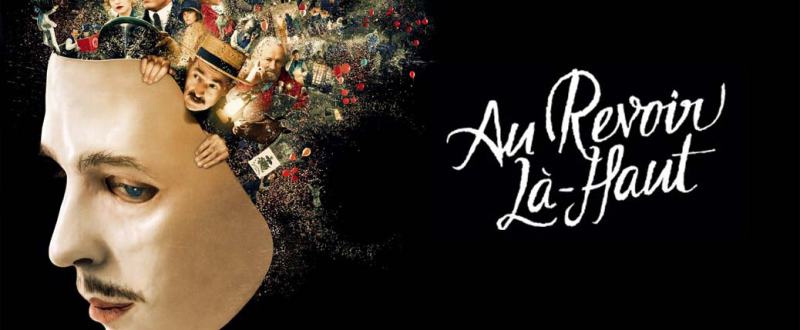
Actor Laurent Lafitte in Conversation with Gemma King

The 2018 French Film Festival began last week and runs until March 28! The Canberra programme is available here, including several special events with partners like the High Commission of Canada and the National Gallery of Australia.

Image result for see you up there film

This coming Wednesday, March 7, actor Laurent Lafitte will be attending the 6.30pm screening of his film Au revoir là-haut (See You Up There), followed by a Q&A in conversation with Gemma King.

Lafitte also starred in 2016’s Elle alongside Isabelle Huppert and hosted the 2017 opening and closing ceremonies of the Festival de Cannes. Tickets for this event are being sold at standard screening prices and can be found here.

Monique Rooney on Beyoncé’s Lemonade

Please join us for the first CuSPP weekly seminar of 2018!

Beyoncé’s Lemonade (2016) as intermedial middlebrow

Thursday 8 March, 1pm, Milgate Room, AD Hope Bldg, SLLL

Prevailing accounts of middlebrow as ‘reception practice’ create difficulties for tracking middlebrow across ‘borders’ and raise ‘issues such as audience and address, genre and authorship and legibility and universality’ (Galt and Schoonover). Closely reading Beyoncé’s Lemonade, this paper attends to the artist’s role as go‐between in the context of  the diverse media that her film both incorporates and re‐enacts. Elucidating how its modes of address and intermedial forms straddle race, gender and sexual categories, I will read Beyoncé’s film in conjunction with debates about middlebrow and the politics of African‐American women’s cultural production. Challenging the routine consignment of middlebrow orientation to a purely bourgeois aesthetics and politics, this paper reads Beyoncé as an intermediary figure and Lemonade as intermedia to argue that its modes and forms work to summon an ‘everwidening community’ (Vernallis).

Monique Rooney is a senior lecturer in the English, Film and Drama Program, ANU. She has published widely on American and Australian film, television and literature. Living Screens: Melodrama and Plasticity in Contemporary Film and Television was published, as part of Rowman and Littlefield International’s ‘Disruptions’ series, in 2015. She is currently co‐editing a special ‘Queer Objects’ issue of Angelaki, which includes her essay ‘Queer Objects and Intermedial Timepieces: Reading S‐Town (2017)’.

Frankenstein: 200 Years of Monsters, CFP Extended

The deadline for the conference Frankenstein: 200 Years of Monsters, being hosted at the HRC from September 12-15 2018, has been extended until 6 April.

Please circulate among your networks and consider submitting a proposal to russell.smith@anu.edu.au. More information is available here.

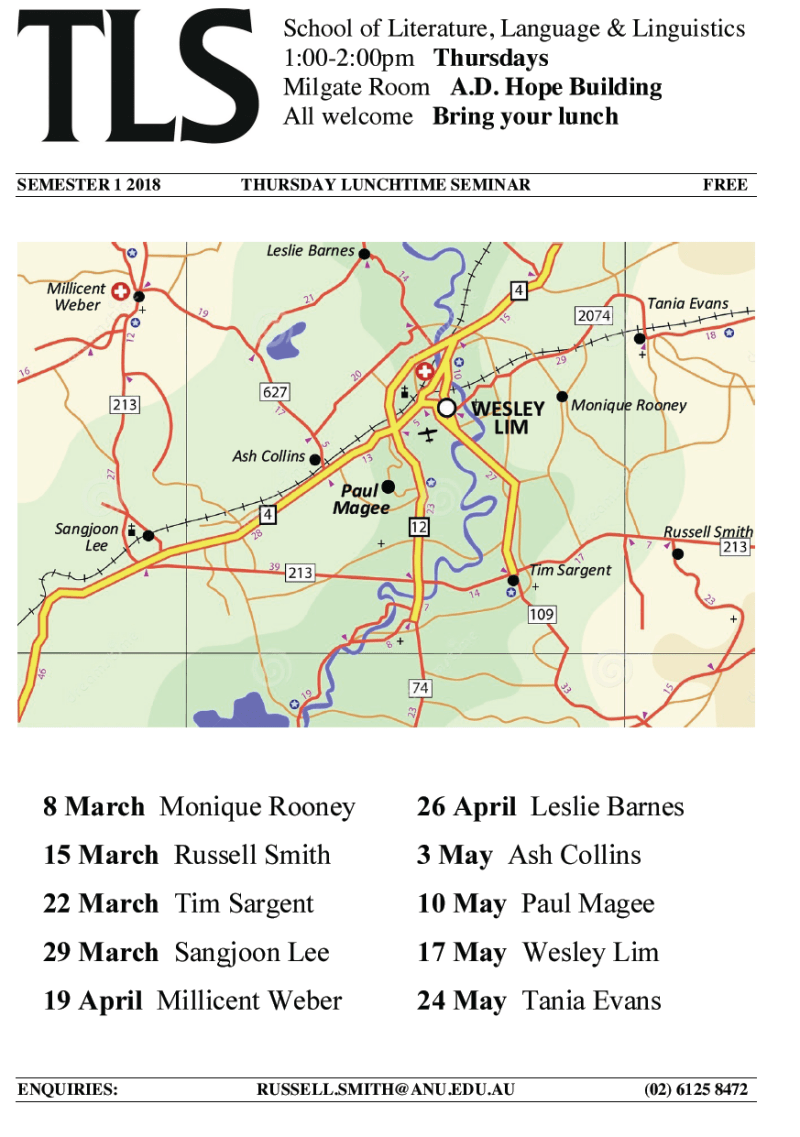
The CuSPP weekly seminar series also begins next week, on Thursdays from 1-2pm in the Milgate Room. Here’s this semester’s program:

Untitled.png