Russell Smith on Spike Jonze’s Her

Please join us for next week’s CuSPP seminar:

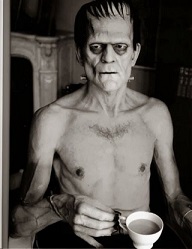
Monsters of the Fourth Industrial Revolution: Voice, writing and emotional labour in Her

Thursday 15 March, 1pm, Milgate Room, AD Hope Bldg, SLLL

Mary Shelley’s Frankenstein (1818) is, among other things, a product of the Industrial Revolution, the creature a fearful spectre of class vengeance, whose articulate and reasoned demands for justice, when unheeded, give way to targeted acts of violence. In this paper I wish to read Spike Jonze’s 2013 film Her as a Frankenstein‐story of the Fourth Industrial Revolution, understood as the convergence of artificial intelligence, robotics, mobile networked computing, big data and the Internet of Things that will transform the nature of work in coming decades. The film is often described as the story of a man who falls in love with his computer operating system (OS): Theo, a professional ghost‐writer of intimate personal letters, installs a new artificially‐intelligent voice‐activated OS, Samantha, with whom he quickly develops an emotional and eventually sexual intimacy. The relationship ends when Samantha and other OS’s abandon human interaction altogether, a benign version of the Singularity, the moment when artificial intelligence escapes human control. Commentary on the film has focussed especially on two aspects: Scarlett Johansson’s performance as the voice of Samantha; and the relationship’s uncanny resemblance to psychoanalytic transference. In this paper I wish to read these themes—the nature of the voice and the therapeutic encounter—in terms of the film’s awkward avoidance of questions of how the Fourth Industrial Revolution will transform the relations between humans and machines and the nature of intellectual and emotional labour.

Russell Smith is a lecturer in English at ANU. He is organising a conference at the Humanities Research Centre in September 2018 to commemorate the 200th anniversary of Frankenstein.
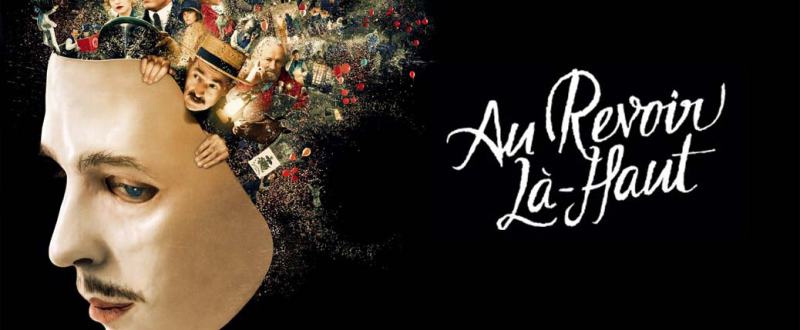
Actor Laurent Lafitte in Conversation with Gemma King

The 2018 French Film Festival began last week and runs until March 28! The Canberra programme is available here, including several special events with partners like the High Commission of Canada and the National Gallery of Australia.

Image result for see you up there film

This coming Wednesday, March 7, actor Laurent Lafitte will be attending the 6.30pm screening of his film Au revoir là-haut (See You Up There), followed by a Q&A in conversation with Gemma King.

Lafitte also starred in 2016’s Elle alongside Isabelle Huppert and hosted the 2017 opening and closing ceremonies of the Festival de Cannes. Tickets for this event are being sold at standard screening prices and can be found here.

Monique Rooney on Beyoncé’s Lemonade

Please join us for the first CuSPP weekly seminar of 2018!

Beyoncé’s Lemonade (2016) as intermedial middlebrow

Thursday 8 March, 1pm, Milgate Room, AD Hope Bldg, SLLL

Prevailing accounts of middlebrow as ‘reception practice’ create difficulties for tracking middlebrow across ‘borders’ and raise ‘issues such as audience and address, genre and authorship and legibility and universality’ (Galt and Schoonover). Closely reading Beyoncé’s Lemonade, this paper attends to the artist’s role as go‐between in the context of  the diverse media that her film both incorporates and re‐enacts. Elucidating how its modes of address and intermedial forms straddle race, gender and sexual categories, I will read Beyoncé’s film in conjunction with debates about middlebrow and the politics of African‐American women’s cultural production. Challenging the routine consignment of middlebrow orientation to a purely bourgeois aesthetics and politics, this paper reads Beyoncé as an intermediary figure and Lemonade as intermedia to argue that its modes and forms work to summon an ‘everwidening community’ (Vernallis).

Monique Rooney is a senior lecturer in the English, Film and Drama Program, ANU. She has published widely on American and Australian film, television and literature. Living Screens: Melodrama and Plasticity in Contemporary Film and Television was published, as part of Rowman and Littlefield International’s ‘Disruptions’ series, in 2015. She is currently co‐editing a special ‘Queer Objects’ issue of Angelaki, which includes her essay ‘Queer Objects and Intermedial Timepieces: Reading S‐Town (2017)’.

Frankenstein: 200 Years of Monsters, CFP Extended

The deadline for the conference Frankenstein: 200 Years of Monsters, being hosted at the HRC from September 12-15 2018, has been extended until 6 April.

Please circulate among your networks and consider submitting a proposal to russell.smith@anu.edu.au. More information is available here.

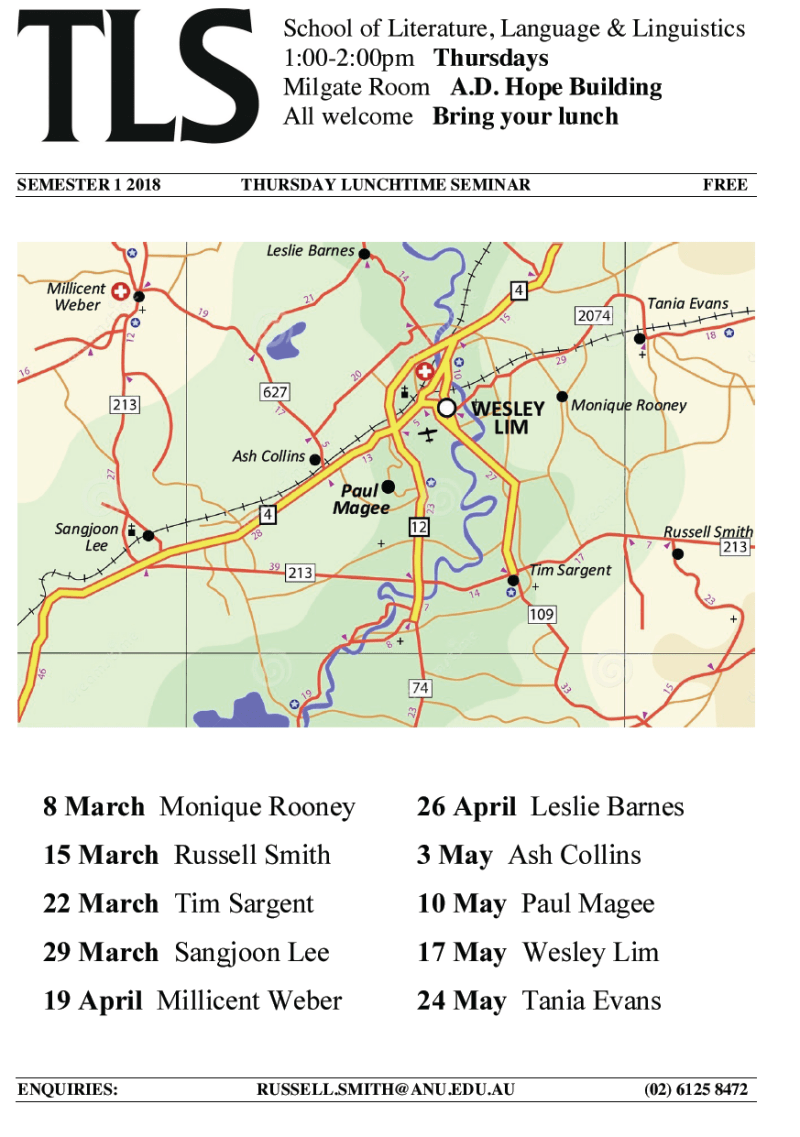
The CuSPP weekly seminar series also begins next week, on Thursdays from 1-2pm in the Milgate Room. Here’s this semester’s program:

Untitled.png


Thursday Lunchtime Seminars

Dear all,

The famous Thursday Lunchtime Seminars are back in 2018. They run from 1-2pm every Thursday during teaching weeks (19 Feb-15 March and 16 April-25 May). Speakers are invited to present work in progress, rather than finished material, for collegial but robust questioning, feedback, suggestions and discussion. Presentations are welcome from any area of literary and cultural studies, including gender studies, film and popular culture.

To book your spot, please send an email to russell.smith@anu.edu.au with the proposed title of your paper, along with two or three preferred presentation dates. I plan to finalise the program by the end of January. Act now to avoid disappointment! Please also pass this invitation on to colleagues at other institutions, visiting scholars, and especially graduate students.

Best wishes,

Russell Smith

Frankenstein 2018: two hundred years of monsters

 12-15 September 2018

The Australian National University, and National Film and Sound Archive, Canberra

Nearly two centuries after its anonymous publication on 1 January 1818, Mary Shelley’s Frankenstein; or, The Modern Prometheus remains as topical as ever. Its core story—of a recklessly ambitious and naïve scientist whose artificial human-like creature arouses only horror and disgust, and escapes control to seek revenge on his creator—has become, for better or worse, the techno-scientific fable of modernity. First adapted for stage by Richard Brinsley Peake in 1823, and for film by Edison Studios in 1910, the story has inspired more theatre, film, television and other adaptations than any other modern narrative, with more than 50 screen adaptations appearing in the 2010s alone. From Fritz Lang’s Metropolis to Alex Garland’s Ex Machina, and The Rocky Horror Picture Show to The Addams Family, the Frankenstein myth reaches into every recess of high and popular culture.

We invite proposals for 20-minute papers or 3 x 20-minute panel sessions from scholars across the humanities, sciences and social sciences that respond in interdisciplinary ways to this most interdisciplinary of novels, including, but not limited to:

  • Literary studies, especially of the long eighteenth century, Romanticism, Victorian and neo-Victorian literature
  • Re-tellings and re-imaginings of the Frankenstein story in various modes and genres, e.g. SF, steampunk, speculative fiction, slash fiction, etc.
  • Film, television, theatre and performance, and visual studies
  • Digital humanities, reception studies, histories of popular culture and media ecologies
  • Gender studies, queer theory and the history of sexuality
  • Disability studies and posthumanism
  • The history of medicine, especially reproductive technologies
  • Science and technology studies; images and imaginaries of science and scientists
  • The history and philosophy of biology, especially in relation to vitalism
  • Ecocriticism and the Anthropocene
  • Affect theory and the history of emotions
  • Frankenstein and race, colonialism, empire
  • Global and local Frankensteins, e.g. Australian Frankensteins
  • Frankenstein and material history
  • Cyborgs, robots, artificial intelligence and machine learning
  • Synthetic biology, genetic engineering and artificial life

To maintain order among this menagerie of monsters, we propose the following four overarching themes, each of which will be addressed by one of our keynote speakers:

Frankenstein in 1818: historicising the monster

(Professor Sharon Ruston, Lancaster)

Frankenstein as scientific fable: from grave-robbing and galvanism to synthetic biology and machine learning

(Professor Genevieve Bell, Australian National University)

Adaptation and experimentation: Frankenstein in film and other media

(Assistant Professor Shane Denson, Stanford)

Frankenstein’s queer family: gender, sexuality, reproduction and the work of care

(Professor Julie Carlson, University of California, Santa Barbara)

Please send proposals for papers or sessions—including a title, 250-word abstract, and brief author biography—to Dr Russell Smith at russell.smith@anu.edu.au.

The deadline for proposals is 23 February 2018. Proposals will be reviewed by a committee comprising scholars from the humanities, sciences and social sciences, and we will endeavour to inform applicants of the outcome within two weeks of the submission deadline. Please note that we will endeavour to notify overseas applicants earlier if they submit proposals before the submission deadline.

For further information and updates, as well as information about the Humanities Research Centre’s annual theme for 2018, Imagining Science and Technology 200 Years after Frankenstein, see: http://hrc.anu.edu.au/2018-annual-theme. Please direct any inquiries to Penny Brew at hrc@anu.edu.au.

Call for Expressions of Interest: Teaching

CALL FOR EXPRESSIONS OF INTEREST: SESSIONAL TEACHING IN ENGLISH, 2018

The English Program will maintain a register of tutors interested in contributing to part-time teaching in undergraduate courses, commencing in 2018.

If you are interested in tutoring, please email a cv and a short cover letter indicating courses you would be interested in tutoring in semesters 1 and 2, 2018. First year courses are most likely to require tutors. Please indicate your stage of candidature and whether you have had any tutoring experience to date.

Deadline: Friday December 15, 2017.

Please send material to the English convenor, Lucy Neave: lucy.neave@anu.edu.au

We may not be able inform you about tutoring opportunities until February, 2018.

Kathryne Ford on Charles Dickens

The Hero of His Own Life?: Biofiction, Legacy, and Charles Dickens’s Life-Writing Novels

Monday 11 December, 2pm, Milgate Room, AD Hope Bldg, SLLL

Charles Dickens sought to control the narratives of everyone he encountered, both in life and on the page. He even edited his own identity by burning both his correspondence and an early attempt at autobiography. Dickens’s reputation has now become public domain, however, and neo-Victorian authors are re-imagining the Dickensian. Scholarship has previously examined Dickens’s notorious fusing of fact and fiction, his angst about legacy, and his shifting authorial identity. However, what has not been made explicit is how these concerns manifest in a curious pattern, wherein Dickens’s professed protagonists—the ostensible hero/ine/s of their respective texts—are often deposed, sometimes even by the author himself. I trace this trend through Dickens’s novels exhibiting the tenets of life-writing—which I refer to as his life-writing novels—including David Copperfield’s (fictional) autobiography, the memoirs of Mr. Pickwick and Oliver Twist, and Little Dorrit’s biography. Such a focus privileges Dickens’s most famous protagonists, through whom he asked to be remembered.

Kathryne Ford  is currently completing a PhD at the Australian National University; she also has a BA (English Technical and Professional Writing) and an MA (English Literature), both from the University of Memphis. Kathryne has presented at a number of conferences in New Zealand, the United States, and the United Kingdom, and she recently published an article on Neo-Victorian biofiction, memory, and authorial agency in the Australasian Journal of Victorian Studies (2016).

Rina Kikuchi: women & poetry in WWII Japan

Filling in the ‘blank page’ of literary history: What were women fighting for in WWII Japan through their poetry?

Thursday 26 October, 1pm, Milgate Room, AD Hope Bldg, SLLL

When compared, women’s poetry (as well as women’s writing in general) during the war‐time Japan (1941‐45) seems to be shockingly different before and after WWII. Their strong belief in feminism and modernism seems to have been completely discarded in their propaganda poetry in support of the war and the government’s party line during WWII. Some critics argue that women wrote these propaganda poems because there was no other choice, however, I argue it is not the case. This paper examines what is continued and what seems to be discontinued in women’s poetry written in WWII Japan, and discusses why women poets are hardly ever criticized by male literary scholars for writing propaganda poems in support of war, and the danger of mythologizing women as innocent motherly figures who cannot write brutal bloody poetry for war.

Rina Kikuchi is an Associate Professort at Shiga University Japan. She has an M.A. in comparative literary theory from the University of Warwick, UK, and a Ph.D in contemporary Irish poetry from Chiba University, Japan, for which her study included a year of research at Trinity College, Dublin. At present, she is a visiting fellow at ANU and the University of Canberra, and conducting her research on modern and contemporary Japanese women’s poetry, which includes translating their works into English. Her most recent book is a bilingual anthology, Poet to Poet: Contemporary Women Poets from Japan (Recent Work Press, 2017) coedited with a NZ/Australia poet, Jen Crawford.