ANU’s Theory Reading Group

ANU’s Theory Reading Group (TRG) is on this Friday 2nd September, 4-6pm in the AD Hope Common Room (ANU), first floor above the Classics Museum.

The texts under discussion are two recent articles from New Left Review, Luc Boltanski & Arnaud Esquerre’s “The Economic Life of Things” and Marco D’Eramo’s “Dock Life”.

There are a number of suggestions on the table for coming weeks, continuing the vein of analyses dealing with the affective dimensions of late capitalism: a chapter or two from Eva Illouz’s Cold Intimacies: The Making of Emotional Capitalism; Fredric Jameson’s ‘controversial manifesto’ An American Utopia, and/or, William Davies’ essay (also from NLR), ‘The Political Economy of Unhappiness’; or even, an oldie but a goodie, Jacques Attali’s Noise. We’ll decide on Friday.

Hope to see you there & feel free to bring drinks, snacks, friends, fellow travellers, shipping containers packed with luxury goods, etc.

Russell Smith

Ps. Please do get in touch if you want to join TRG. We’ll sign you up to our mailing list and link you to the dropbox file of weekly readings.
Lunchtime Seminar: Kate Flaherty on “Richard III” and the colonial theatre public

On the edge of chaos: Richard III and the colonial theatre public

Thursday 1 September, 1pm Milgate Room, AD Hope Bldg, SLLL

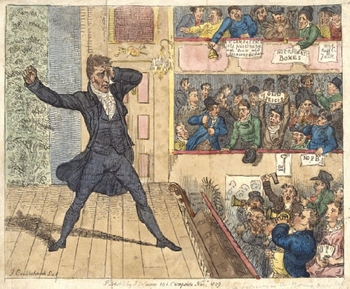
On 26 December 1833, the first licenced theatre in New South Wales offered its first Shakespeare play—Colley Cibber’s adaptation of Richard III. The event entailed a riot in which the actor playing Gloucester hurled an audience member from the stage. Using insights drawn from scholarship on the Covent Garden ‘Old Price Riots’ in 1809, this paper will investigate the Sydney Theatre Royal’s 1833 disturbance as an indicative phase in the development of a colonial theatre public. Thirty years after this vexed beginning, majestic theatre venues hosted international stars throughout Australia’s major cities. What constituted this rapid cultural transformation? This paper demonstrates how the press, satire, and travesty, were active agents in the process through their performative negotiation of the penal colony’s troubled relationship with Shakespeare. Central to the narrative is Richard III, a drama of disrupted authority which (with Othello) was, uncannily, the most popular play on the colonial Australian stage.

Kate Flaherty is a lecturer in English and Drama in SLLL. Her monograph Ours as we play it: Australia plays Shakespeare (UWAP, 2011) examined three plays in performance in contemporary Australia. More recent work investigates Shakespeare on the colonial stage and the public interplay of the dramas with education, imperial politics and sectarian friction. Her work has been published in Contemporary Theatre Review, Australian Studies and Shakespeare Survey.